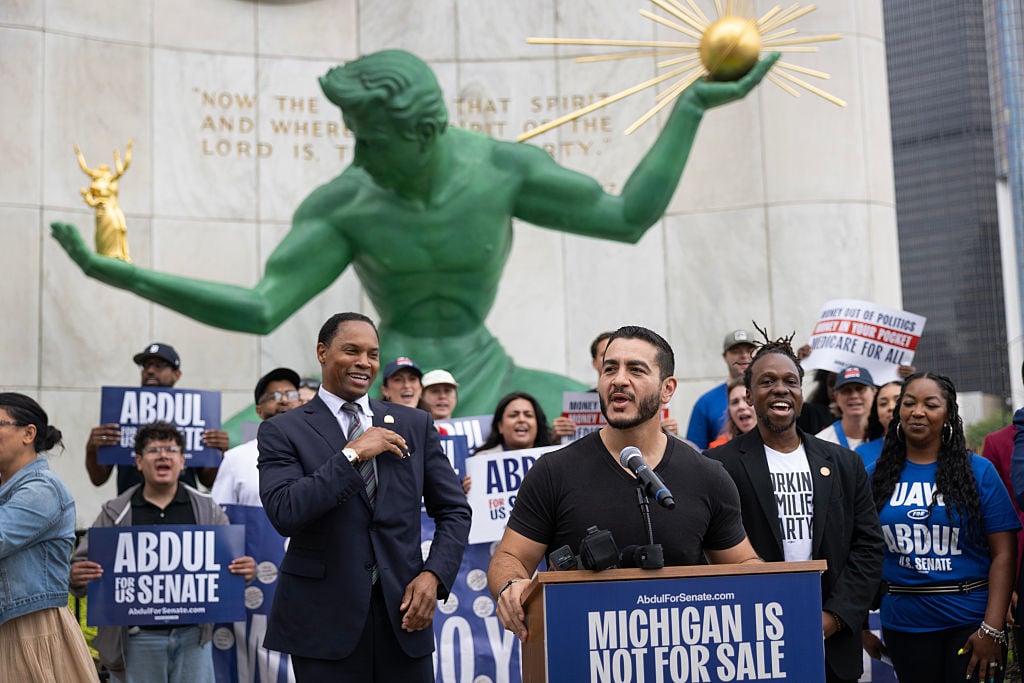
One of the most high-profile primary races of the 2026 midterm cycle played out in Michigan, with a progressive Democratic Senate candidate defeating a centrist, establishment-backed Democratic opponent. Now, attention turns to the general election, in which Democrats have to be concerned about healing intraparty divisions in order to compete with the GOP for a pivotal Senate seat.
Progressive public health expert defeats establishment candidate despite outside spending
Early Wednesday morning, NBC News projected Abdul El-Sayed as the winner of Michigan’s Democratic primary for the state’s open U.S. Senate seat, defeating Democrat Rep. Haley Stevens. The race was one of the most highly-publicized primary elections in the country, with tens of millions of dollars pouring into the race. The election was presented as a contest between the progressive El-Sayed, a physician and epidemiologist who previously served as a public health official and unsuccessfully ran for governor of Michigan in 2018, against the centrist Stevens, who has represented Michigan’s 11th District since 2019. El-Sayed’s victory is significant given that Stevens had the backing of a number of established Democratic figures, including Michigan Gov. Gretchen Whitmer, outgoing Democratic Sen. Gary Peters and Senate Minority Leader Chuck Schumer (D-New York). Stevens and her allies also enjoyed a nearly 9-to-1 advertising spending advantage over El-Sayed, with nearly $65 million spent in advertising for Stevens against El-Sayed.
Divisions over domestic and foreign policies
El-Sayed leaned on his progressive policies and backers. The doctor and former public health chief for Detroit promoted domestic policies including “Medicare for All.” El-Sayed’s progressive campaign comes as other left-leaning candidates, many associated with the Democratic Socialists of America (DSA), have won key Democratic primaries across the country. El-Sayed is not a member of the DSA and was not formally endorsed by the organization, but popular DSA figures, including Sen. Bernie Sanders of Vermont and Rep. Alexandria Ocasio-Cortez of New York, campaigned for him heavily. El-Sayed has also been highly critical of Israel, accusing the country of committing genocide in Gaza, and he accused Stevens of being too close to the American Israel Public Affairs Committee (AIPAC), the influential pro-Israel lobbying group that spent tens of millions of dollars to support Stevens in the race. The criticisms of AIPAC and Israel’s war in Gaza resonated in Michigan, which has large Arab and Muslim populations; support for the war is thought to have hurt Vice President Kamala Harris in Michigan during the 2024 presidential race.
Task ahead: unifying Democrats, defeating Republicans
With the primary concluded, attention turns to November’s general election. The Michigan seat is seen as one that Democrats must hold as part of their difficult but possible quest to retake control of the Senate from Republicans. El-Sayed will now face Trump-backed Republican Mike Rogers, a former U.S. congressman who won Tuesday’s Republican primary unopposed. Stevens’ campaign had presented her as the more competitive candidate for the general election, and Republicans fed into that narrative by indicating that they preferred to face El-Sayed in November. President Trump told Fox News, “Based on the polls, he’ll do much better against Abdul than he’s going to do against the congresswoman.” El-Sayed and his supporters, meanwhile, have argued that the progressive message was resonating more with voters than the establishment. However, given the divisive nature of the primary race and the personal attacks made by each candidate’s camp against one another, unifying Democrats around El-Sayed may prove challenging. The newly minted Democratic nominee acknowledged the task ahead for him, telling CBS Mornings Wednesday that “there’s a lot of healing to do after a hard-fought primary like this.”
Democrats are facing twin challenges heading into November: attempting to unify the progressive and centrist wings within the party while also seeking to outcompete Republicans in key congressional races. El-Sayed now faces those tasks in Michigan, and his performance between now and November will be a major test of the progressive surge within the Democratic Party and how much the left-leaning appeal will resonate with voters.