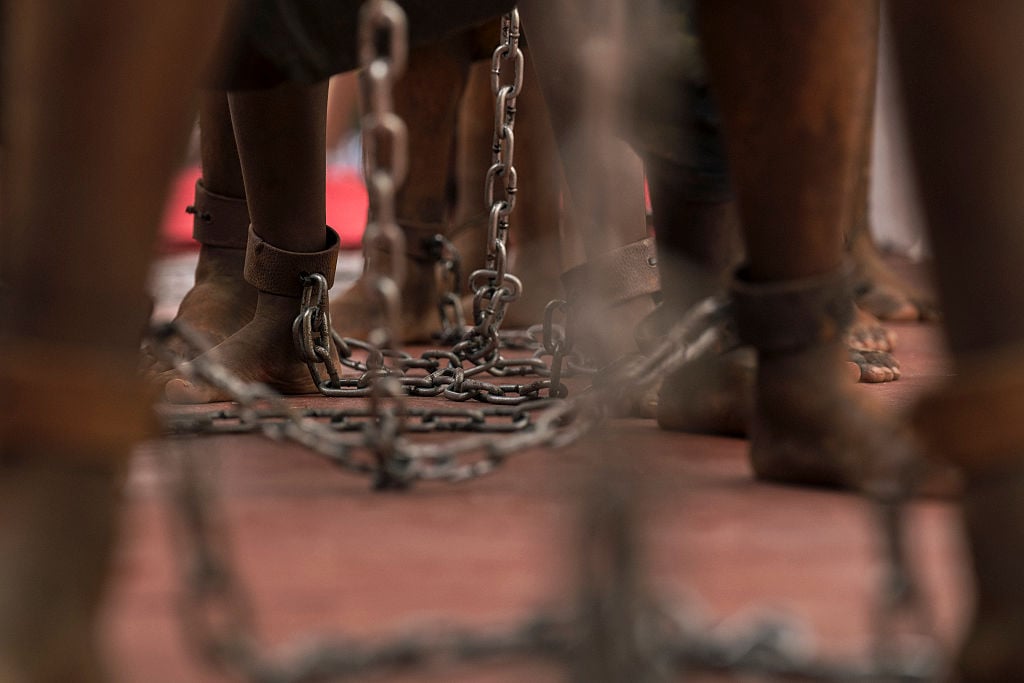
Performers reenact the trans-Atlantic slave trade at Christiansborg Castle, a former slave trading post, during the high-level consultative conference on the next steps to the landmark United Nations resolution on the trafficking of enslaved Africans on June 19, 2026, in Accra, Ghana. The "Next Steps" conference is taking place in Accra from June 17-19, bringing together leaders and experts from more than 80 countries, in the first gathering of its kind since the United Nations (UN) resolution declaring the trafficking of enslaved Africans as the gravest crime against humanity. UN Resolution A/RES/80/250, adopted on March 25, established a global framework for reparatory justice. | Photo by Ernest Ankomah/Getty Images
African and Caribbean nations have outlined a plan for reparatory justice as they demand apologies from countries that participated in the transatlantic slave trade. Representatives from the nations gathered in Accra, Ghana, on Friday at the High-Level Consultative Conference on the Next Steps to the Landmark United Nations Resolution on the Trafficking of Enslaved Africans to approve a 19-point framework for reparations, The Guardian reported.
What is outlined in the framework for reparations?
The reparations framework calls on “all state and non-state institutions” that have not yet provided justice for the transatlantic slave trade to do so. According to the document, those institutions must “offer full, formal and unconditional apologies as a foundational step towards reconciliation, trust-building and reparatory justice.”
ACCRA, GHANA – JUNE 19: John Dramani Mahama, President of the Republic of Ghana, lays a wreath at the Christiansborg Castle during the high-level consultative conference on the next steps to the landmark United Nations resolution on the trafficking of enslaved Africans on June 19, 2026, in Accra, Ghana. The “Next Steps” conference is taking place in Accra from June 17-19, bringing together leaders and experts from more than 80 countries, in the first gathering of its kind since the United Nations (UN) resolution declaring the trafficking of enslaved Africans as the gravest crime against humanity. UN Resolution A/RES/80/250, adopted on March 25, established a global framework for reparatory justice. (Photo by Ernest Ankomah/Getty Images)ACCRA, GHANA – JUNE 19: John Dramani Mahama, President of the Republic of Ghana, Mia Amor Mottley, Prime Minister of Barbados, Samuel Okudzeto Ablakwa (MP), Minister for Foreign Affairs, Ghana, and other dignitaries attend a wreath-laying event at the Christiansborg Castle, a former slave trading post, during the high-level consultative conference on the next steps to the landmark United Nations resolution on the trafficking of enslaved Africans on June 19, 2026, in Accra, Ghana. The “Next Steps” conference is taking place in Accra from June 17-19, bringing together leaders and experts from more than 80 countries, in the first gathering of its kind since the United Nations (UN) resolution declaring the trafficking of enslaved Africans as the gravest crime against humanity. UN Resolution A/RES/80/250, adopted on March 25, established a global framework for reparatory justice. (Photo by Ernest Ankomah/Getty Images)ACCRA, GHANA – JUNE 19: Performers reenact the trans-Atlantic slave trade at Christiansborg Castle, a former slave trading post, during the high-level consultative conference on the next steps to the landmark United Nations resolution on the trafficking of enslaved Africans on June 19, 2026, in Accra, Ghana. The “Next Steps” conference is taking place in Accra from June 17-19, bringing together leaders and experts from more than 80 countries, in the first gathering of its kind since the United Nations (UN) resolution declaring the trafficking of enslaved Africans as the gravest crime against humanity. UN Resolution A/RES/80/250, adopted on March 25, established a global framework for reparatory justice. (Photo by Ernest Ankomah/Getty Images)ACCRA, GHANA – JUNE 18: African leaders attend the High-Level Consultative Conference on the Next Steps to the Landmark United Nations Resolution on the Trafficking of Enslaved Africans, in Accra, Ghana on June 18, 2026 in Accra, Ghana. The “Next Steps” conference is taking place in Accra from June 17-19, bringing together leaders and experts from more than 80 countries, in the first gathering of its kind since the United Nations (UN) resolution declaring the trafficking of enslaved Africans as the gravest crime against humanity. UN Resolution A/RES/80/250, adopted on March 25, established a global framework for reparatory justice. (Photo by Ernest Ankomah/Getty Images)ACCRA, GHANA – JUNE 18: Corinne Amori Brunet, Minister for Foreign Affairs of the Republic of Benin, speaks during a plenary session at the high-level consultative conference on the next steps to the landmark United Nations resolution on the trafficking of enslaved Africans on June 18, 2026, in Accra, Ghana. The “Next Steps” conference is taking place in Accra from June 17-19, bringing together leaders and experts from more than 80 countries, in the first gathering of its kind since the United Nations (UN) resolution declaring the trafficking of enslaved Africans as the gravest crime against humanity. UN Resolution A/RES/80/250, adopted on March 25, established a global framework for reparatory justice. (Photo by Ernest Ankomah/Getty Images)ACCRA, GHANA – JUNE 18: Participants at the High-Level Consultative Conference on the Next Steps to the Landmark United Nations Resolution on the Trafficking of Enslaved Africans on June 18, 2026 in Accra, Ghana. The “Next Steps” conference is taking place in Accra from June 17-19, bringing together leaders and experts from more than 80 countries, in the first gathering of its kind since the United Nations (UN) resolution declaring the trafficking of enslaved Africans as the gravest crime against humanity. UN Resolution A/RES/80/250, adopted on March 25, established a global framework for reparatory justice. (Photo by Ernest Ankomah/Getty Images)
“We recognize and honor the extensive efforts undertaken over generations by several governments, intergovernmental organizations, our forebearers, individuals and civil society partners across Africa, the Caribbean, the Americas, as well as in Europe and Asia in shaping the global reparations agenda,” the document states.
“We adopt this document as a basis for global collaboration and commit to engaging in transparent, constructive and good faith dialogue in advancing reparations and reparatory justice among all state and non-state actors.”
Ruth Ogbewekon, who led the project on reparatory justice at the Pan African Lawyers Union, said the framework was developed with officials from Africa, the African diaspora and non-African allies.
“Ultimately, it was a process where people wanted to be heard and to see that they were heard, and the events in Accra provided that,” Ogbewekon said, per The Guardian.
Ghana hosts slave trade reenactment during Juneteenth observance
As leaders gathered in Accra to advance their reparations efforts, the city also hosted a reenactment depicting the transatlantic slave trade, Al Jazeera reported.
The event took place near a fortress in Accra on Juneteenth. The site was one of the locations connected to the transatlantic slave trade and served as a backdrop for the commemoration.