
Last spring, DJ Hamlin was sitting in the living room of his Bed-Stuy apartment with friends when an ad for former New York Gov. Andrew Cuomo’s mayoral campaign flashed across the TV.
“Hey guys, we’re voting for Zohran Mamdani, right?” Hamlin remembers asking.
His friends collectively hesitated. Cuomo was familiar. He’d served in public office already. Who was going to beat him anyway?
For Hamlin, the slightly awkward moment reflected more than simple political disagreement. It showed a real sense of complacency among voters who had been conditioned to see establishment figures as the only viable option.
At the time, Mamdani’s outsider mayoral campaign was still polling in the single digits and viewed by many as nearly impossible. But for Hamlin, the campaign represented proof that younger progressive candidates could break through even when political institutions and the status quo counted them out.
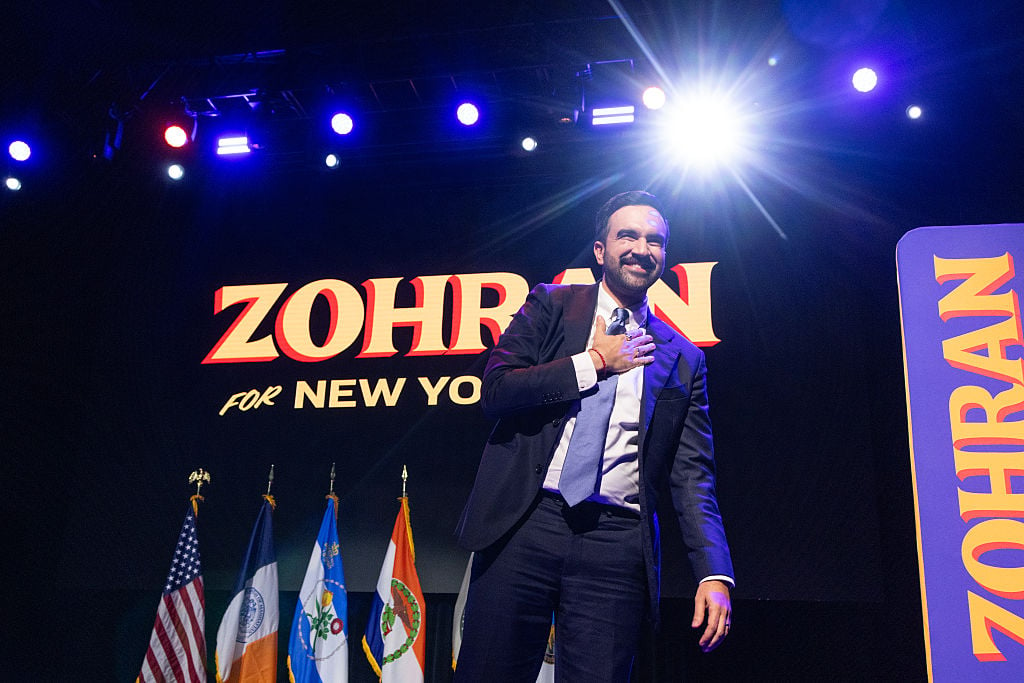
“In my education of political science, policy and government, it was never an ‘Oh, I’m gonna learn this so that I can run,’” Hamlin exclusively told Blavity in a recent interview. “Honestly, I didn’t even feel it until I saw the success of Zohran. It really, really put a battery in my back.”
A Brooklyn resident for a little more than 10 years now, Hamlin canvassed for Mamdani early in the race, speaking with voters, helping people find polling locations and having long conversations with neighbors about the ways their expectations were failing to be met.
“That kind of got me started with really engaging with my own community,” he said. “The act of that got me interested in the mechanics of effecting change.”
Now, the 30-something hospitality worker is launching his own outsider campaign — against one of the most powerful Democrats in the country: Hakeem Jeffries.
In an Instagram post shared earlier this month, Hamlin announced he will challenge Jeffries in New York’s 8th Congressional District as an independent, positioning himself as part of a growing wave of younger progressives deeply dissatisfied with establishment Democratic leadership.
‘The politicians are not working for the people’
Jeffries, the current House Democratic leader and the first Black lawmaker to lead a major party in Congress, has become one of the Democratic Party’s most prominent national figures. On his official congressional website, Jeffries highlights efforts to expand affordable housing, lower prescription drug costs and defend democracy against Republican extremism.
But Hamlin argues many voters — especially younger voters — no longer feel represented by Democratic leadership that he says prioritizes corporate donors and political caution over transformative policy.
“The politicians are not working for the people,” Hamlin said. “They’re not policy-making for the people. They’re not legislating for the people. They’re not even listening to the people.”
Hamlin’s platform includes Medicare for All, universal basic income, tuition-free college and expanded social housing. Throughout the interview, he repeatedly returned to the idea that economic suffering in the United States is not inevitable, but politically manufactured.
“That to me is why we are where we are,” Hamlin said. “Why we are allowing people to starve and be houseless, and be downtrodden in such avoidable and fixable ways.”
He specifically criticized massive federal spending on war while Americans continue struggling with housing costs, healthcare access and all kinds of debt.
“Almost $30 billion for this war in Iran,” Hamlin said. “They’re talking about a billion dollars for Trump’s ballroom. In December, a lot of the large banks — JP Morgan specifically — were overleveraged … and the Federal Reserve just, out of thin air, gave money to banks. Why can’t that happen for healthcare? Why can’t that happen for housing? For job guarantee programs? College?”
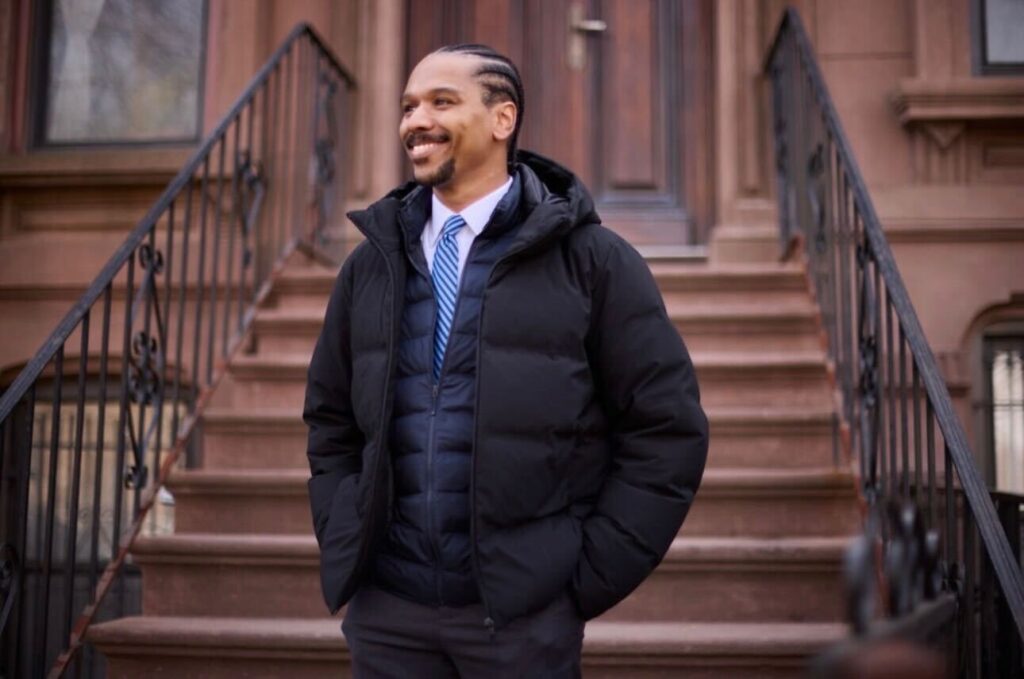
For Hamlin, hospitality and the House go hand in hand
Unlike many progressive candidates whose political identities were shaped primarily through activism or party organizing, Hamlin said his worldview was formed working in restaurants.
The Long Branch, New Jersey, native, who moved to New York in 2015 on a whim, stumbled into hospitality after applying for a hosting job at 19 with no prior experience.
“I was talking to the hiring manager, and it was literally his last day,” Hamlin recalled. “And he looked at me like, ‘F*ck it. Why not?’”
He went on to build a career in hospitality management, an industry he describes as one of the clearest reflections of America itself.
“I know going into a restaurant I’m going to meet people from like 15 different cultures,” Hamlin said.
That experience, he said, fundamentally shaped how he thinks about leadership and labor.
“As I transitioned into management from hourly employee, I looked back at the worst managers I worked under,” he said. “And they really were my best teachers.”
Hamlin described intervening between workers and abusive managers, helping staff navigate payroll issues and supporting employees through unionization efforts.
“I’ve had staff members come up to me and say, ‘Hey, listen, I was gonna call out today, but I saw you were on the schedule and decided to come in,’” he said.
For Hamlin, that “people first” mentality now sits at the center of his politics and his long-shot campaign against one of the Democratic Party’s most powerful figures.
Whether the campaign becomes a serious electoral threat remains unclear. Jeffries remains deeply entrenched politically in one of the country’s safest Democratic districts.
But Hamlin said watching Mamdani’s rise taught him that political change often begins long before voters even believe it’s possible.