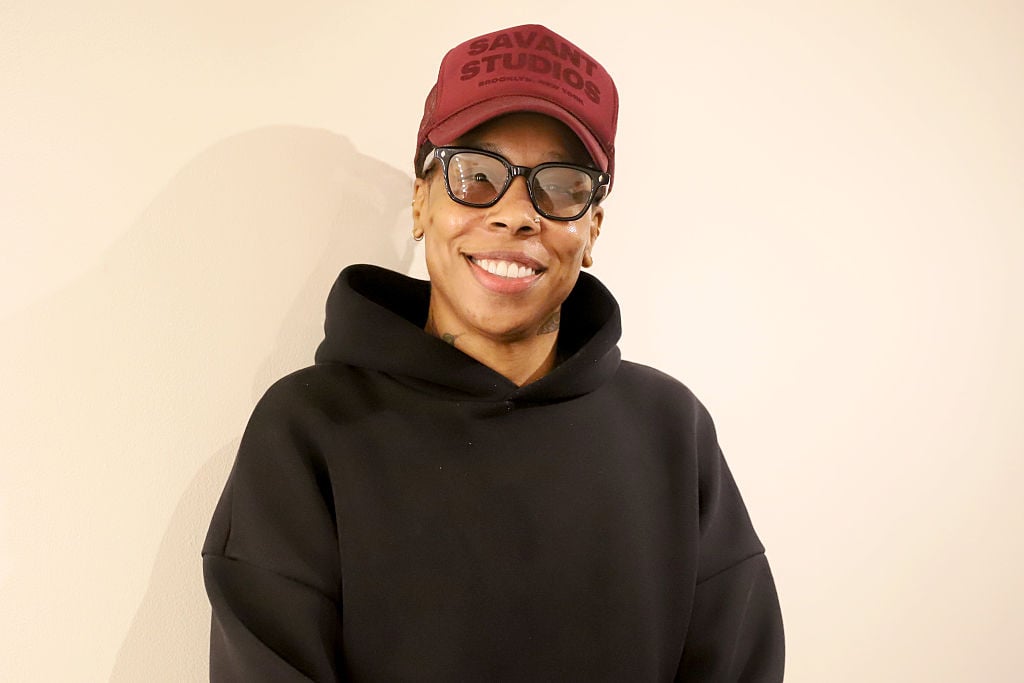
Lena Waithe is taking her writing talents to the stage, literally and figuratively. The Chi creator has teamed up with Baltimore Center Stage’s Artistic Director Stevie Walker-Webb to bring her first stage play to the masses in Charm City, in which Waithe both wrote and is starring, making her stage debut. trinity, directed by Walker-Webb, is described as a bold, intimate, and genre-defying exploration of love, humanity, and the power of imagination.
The show will run in Baltimore from Feb. 12 to March 8 and may have an extended run. Waithe intends on making it a trilogy, so more playwriting is to come. Longtime friends, when Waithe decided to write a stage play, she knew she couldn’t do it without the collaboration and support of Walker-Webb. For Walker-Webb, Waithe is a muse. Both are admirers of one another’s work. And despite this being an intimidating process for Waithe, it’s been exciting.
In a recent interview with Blavity’s Shadow and Act, Waithe and Walker-Webb spoke with us about the play’s inception and what’s next. Waithe described the difference between the stage and scripted world, noting there’s no ceiling in the theater world, and more creative freedom.
Stevie, with this being Lena’s first play and it being a collaborative effort, she mentioned that when she submitted the script to you, that it was basically in drafts. How did you guide her along in the writing process?
So Avon [Houghton], who I was talking about earlier—drama is a part of my trifecta. So immediately, I read it. Then I sent it to Avon. And Lena is so intentional about who she allows to interact with. We had a general meeting just where I let Avon and Lena meet, and they were supposed to just kind of meet each other. And like two hours later, we were still on the call talking about the play. And basically, what I did was I just held sacred space.
I felt like I slowly began to talk more in the process. The first three months or so was me saying, “Just keep writing, just keep writing, just keep writing.” I knew she was a great writer. I knew the play was good.
The hardest part of the play for me has been about figuring out what the order of the events needs to be, because it’s intentional chaos. That’s how I like to describe it. And so, what is the order that that chaos should exist in? That’s mainly what I did.
She’s fearless, so she just writes from the center of truth. A lot of times you’re trying to get playwrights to scrape the bull off the top to get to the thing, and she puts the thing in the middle of the page. And then, she took what Lynnard said literally about letting the smoking gun off in the first 15 minutes, and so then it was just like, “Whoa, whoa, whoa, whoa, let’s pace this out, let’s pace this out.” Because she was so ready to just tell all the truth of these characters. So it’s mostly just holding that sacred space, encouraging her to keep writing, and then—I think confusion is productive, because she’s so clear.
So being able to inject a little bit of productive confusion every time we got off the call. There’s this device in the play called “what ifs,” where you get to see different scenarios played out a little bit. And so we started playing what-if in our writing process with Lena. We would ask her questions, Yvonne and I are like, “What if this happened?” And she’s such a sponge as a writer. That is not normal. I actually thought that would be the hardest part working with her because she’s so established.
Her voice is so established, and sometimes you’ll tell a writer something, and they’ll be like, “Oh, I can’t do it that way.” She’ll take your idea and put it in a blender and bring you back something that you weren’t even going for. But then, often it’s quite sharper, quite better, and even more distilled. S,o holding space, trying to provide productive confusion, and just encouraging her to go for it.
And you talked about her being a sponge. You also mentioned that she’s grounded on stage, which is not something you’ve necessarily experienced before. Obviously, she is great at what she does in terms of her writing and producing. What else would you say makes her different from those you’ve worked with in the past, and how will this help her become a prolific playwright?
She is brutally honest. She is a little bit absurd. I don’t want to use the word genius because it feels so overused, but she really is a genius. She really is. You feel her genius when you’re in the process with her. She can be both in the play and outside of the play. And what’s been really fun is watching her learn to channel her genius in a more focused way.
Sometimes, she’s on stage, and I know that she’s producing. I know that she’s rewriting. She’s also acting and coaching. And so these last two week,s when we’ve just been in the rehearsal space, watching her turn off the light bulbs in the other rooms of her mind so that she can just step into the space—that’s been really cool.
And then also having to be her brother and be patient with her, because this is her first time as an actor, right? To earn that trust, to say, “I got you. You can turn that light bulb off.” And slowly, she started turning off all the other lights, and now she walks into the rehearsal space and her genius is so focused, which is so powerful to watch her do that. And I feel honored by it.
Lena, I’ve read a lot about the play. And one of the central themes is the question of the “what if,” as Stevie spoke to. What is fascinating to you about the whole fantasy versus reality thing?
Someone asked me what the difference between a fantasy and a “what if,” particularly in the play, is, and I say, a fantasy is a whimsical and exciting idea, and a “what if” is a question you don’t wanna know the answer to, but you ask it anyway. I think I’m less fascinated by fantasy, and I’m more curious about “what if,” because it can be a little dangerous.
We like things that are forbidden, or we like things that we aren’t supposed to have, and that’s just part of the human experience. And so sometimes you have to ask a question. You have to touch the stove to know it’ll burn you, so you don’t do it again. But there’s something exciting about touching it to see, “Am I able to surpass humanity and not get hurt?” People are fascinated by superhero movies because of the idea that somebody could be superhuman. It’s the idea of, “O,h I can’t be that, but I wanna live in a world or go look at something where it tells me that maybe I could have superpowers.” And that to me is fascinating—the fact that we’re fascinated by what we can’t attain and how that keeps us up at night, and how we aren’t happy with what we do have. That’s the Wizard of Oz of it all.
Now I want to talk to you about The Chi. So Season 8 is the end. Why is it the best time to end the show?
Because people still care that we’re on. I’d rather go out on a high. You don’t want to go out with a whimper. And you know some of my favorite shows did go out on a whimper. Living Single did. Martin did. Girlfriends went out while on a writer’s strike, and I was an assistant on Girlfriends, and then the strike happened, and we didn’t come back after that. And I’m very much of the lineage of all those shows.
I actually wanted to end the show a little bit sooner, but the desire was still there. And when that is the case, you should continue to keep it going. But I think what happens with the series, after eight seasons, you start to repeat yourself. Some people were saying, “You could keep going.” That’s true. But I care about the integrity of the show. And I do want to make sure that people watch the last season and know the ending. And so I think that’ll be really comforting for the audience, and for me too as a creator.
So that’s a mountain I’m climbing for the first time, too. I’ve never written a last season of a show. I’ve never done the last episode of something. So I’m looking forward to sort of having to go through that mourning process, and also a celebratory process at the same time.
The Chi has registered with so many viewers. I know that you’ve called it your love letter to the city of Chicago. And a lot of the actors are from Chicago, in their first roles. What are you most proud of with this specific project?
I am proud of how many people we’ve been able to give jobs to. We’ve been able to introduce a lot of folks. We got to bring folks back like Jason Weaver and Lynn Whitfield. And then some of these characters—Shamon Brown Jr., who plays Papa, and Mike Epps who plays Jake—and being able to introduce new faces.
But also bringing faces back like Wendy Raquel Robinson on the show. All that kind of stuff. Kadeem Hardison is on the show. Phylicia Rashad is on the show. We’ve been really blessed to work with some people that I and we have all looked up to. Robert Townsend is directing an episode this season. It’s been magical. To me, that has been such a gift—that my heroes got a chance to come and play in the sandbox I created. You can’t beat that.
My final question is about your podcast. I love your podcast. I watch it with such joy, and I think it’s because I can tell that it’s fun for you. You’re in fandom with all of your subjects, and you’re breaking down scenes and the wardrobe and all of those things during each interview. How has that space been for you to kind of just revel and talk to these living legends, versus it feeling like work?
It is such a gift. And I do a lot of preparation. I think people can kind of tell that I’ve seen a lot of this stuff that we delve into in the interviews. But I’m revisiting it for myself and finding new things in the work, and also rewatching it as an older person. A lot of the stuff I’m talking about I watched as a kid. We didn’t understand Waiting to Exhale when it first came out, no matter how much we loved it. At the time, I was 12 when I first watched it. Now I’m 41. I am looking at it through a different lens.
It’s been great because a lot of these artists that I am interviewing haven’t gotten to have their Inside the Actors Studio moment—like Lela Rochon, Kym Whitley, or Loretta Devine.
People don’t even know the full scope of their stories. I’m a theater head. So I got to talk to Loretta Divine about being in Dreamgirls.
I just talked to Jenifer Lewis about being a part of Dreamgirls, but never making it to the stage. A lot of people didn’t know Jenifer Lewis had a part in the show. She was a part of developing it. She was a part of the workshop, but she didn’t make it to Broadway. A lot of people didn’t know Robert Townsend directed B.A.P.S. These are things that I assume people know—that they don’t. So I love being part of that education for the culture.
It’s beena great reception. People will DM me and say, “I watched Hollywood Shuffle for the first time because of the Robert Townsend interview.” And that to me means a lot to me. The NAACP Image Award nomination really is just icing on top of an already really delicious cake. We’re really honored to be nominated, but it really is just a labor of love, and it’s a gift I want to give to these people, because they’ve given me—and all of us—so much.