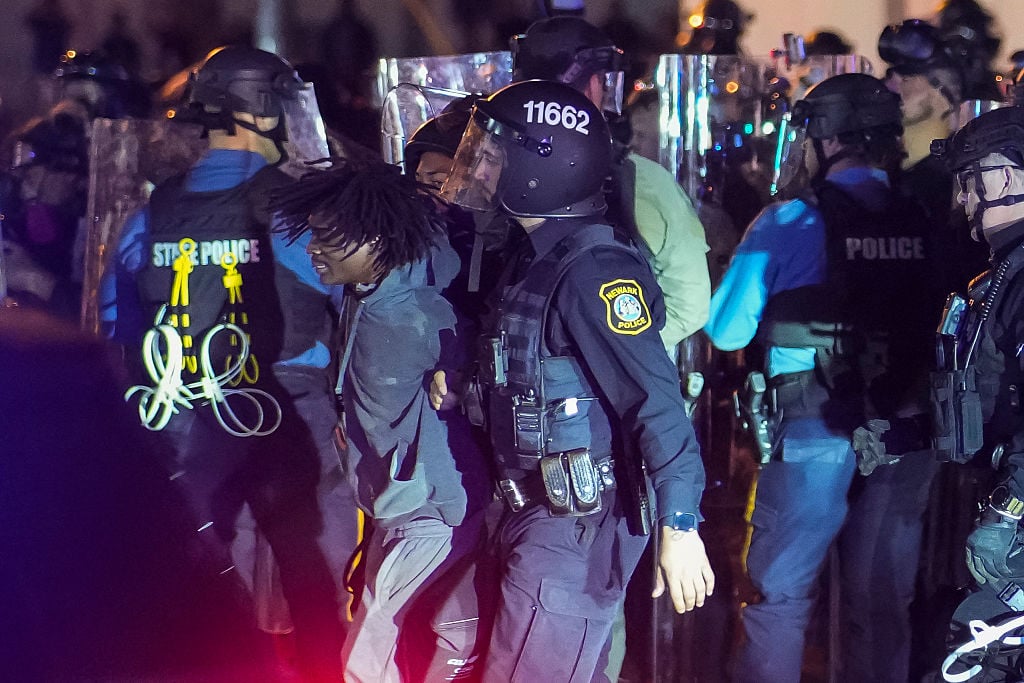
For more than a week, the streets outside Delaney Hall, a privately operated immigration detention center in Newark, New Jersey, have been the site of some of the most intense protest activity the state has seen in years. Demonstrators have faced tear gas and mass arrests, and journalists covering the scene were taken into custody. The governor deployed state police. The mayor imposed a curfew.
Newark Mayor Ras Baraka lifted that curfew this week and removed designated free speech zone restrictions around the facility following a night of protests that resulted in no arrests.
For many, it may seem like the situation has calmed down.
But the people who have been fighting this battle the longest say the most important part of the story hasn’t changed. Inside Delaney Hall, dozens of detainees remain held under conditions that organizers, attorneys and local officials describe as inhumane, and the detainees themselves have been on a hunger and labor strike for months.

“Even though today was an announcement that the curfew was lifted, that is not a win,” said Zellie Imani, an educator and organizer with Black Lives Matter Paterson who has spent days documenting events outside the facility — and keeping the public informed about what’s happening inside — via X.
“The win would be for the detainees to be released,” he told Blavity in an interview.

What’s happening inside?
According to Imani, the hunger strikers’ demands include a meeting with New Jersey Gov. Mikie Sherrill, the release of medically vulnerable, elderly and pregnant detainees, a meaningful review of immigration cases and habeas filings, and an end to coercive pressure on detainees to sign deportation documents.
In a statement published on May 29, the Department of Homeland Security denied the allegations, calling claims about conditions at Delaney Hall “categorically false smears.” The agency said there is no hunger strike at the facility, that detainees receive three meals a day certified by dietitians and that no detainees were beaten or attacked by ICE.

Imani told Blavity that those connected to detainees inside have been receiving accounts describing worm-infested food and physical abuse, particularly targeting those participating in the hunger strike. He also described what he characterized as deliberate isolation being used as punishment against strike leaders.
“[Detainees in] those sections are literally not able to communicate to the outside or have visitation at all,” he said. “They are literally punishing those on hunger strike by taking away any other rights that they have.”
Baraka — who was himself arrested by federal agents outside Delaney Hall a year ago and has since filed a lawsuit alleging malicious prosecution and false arrest — confirmed that some progress has been made through public pressure. Two pregnant women held at the facility have been released, which he attributed to demands from the congressional delegation.

But he was pointed about how much remains unresolved.
“Why do we have 18-year-old girls who are pregnant inside of this place? Why do you have young girls who are having miscarriages?” the mayor said in an exclusive interview with Blavity.
“All of this is important, and they get to avoid answering those questions because we are focused on what’s going on outside of the building.”
The chaos outside the facility also raised serious questions about press freedom. Journalists covering the demonstrations were among those arrested, and according to Adam Rose, deputy director at the Freedom of the Press Foundation, police forced remaining cameras away from the scene entirely.
“We’re poorer as a society without having journalists there to bear witness,” Rose told Blavity, a reality that organizers argue only makes it easier to ignore what’s happening inside.
A private facility. A public fight.
One detail that has received little attention amid the chaos outside is the legal status of Delaney Hall itself. It is not a federal facility but is privately operated under a contract with the federal government, a distinction that organizers and city officials argue carries significant legal weight.
“It’s privately owned. They just happen to have a contract with the federal government,” Imani said.
He argued the facility should be subject to the same local health and safety inspections required of any private business.

“The health department has not been able to inspect the facility. If you’re a restaurant and you get complaints about horrible conditions, the state will come in, give citations, maybe even close you down. But they’re not even being allowed to come in.”
According to NJ.com, the facility has been operating without a certificate of occupancy permit. The City of Newark and the State of New Jersey have filed a lawsuit against the operators of Delaney Hall, citing concerns about conditions at the detention center.
What a real win looks like
With the crisis outside Delaney Hall quieter for now, the question of what constitutes a resolution for those inside remains contested, as the mayor, activists and Democratic lawmakers continue to push for the facility’s closure.
Activists like Imani, however, push back against the idea that the fight ends there.
In a post on X, he wrote: “The closure of Delaney Hall without the release of detainees is not a win. The closure of Delaney Hall but not getting ICE out of New Jersey is not a win. If detainees are transferred out of Jersey that’s not a win. Family separation and violence against detainees would continue.”
Speaking with Blavity, Imani expanded on why.
“If they just shut it down, they just get transferred somewhere else, and that doesn’t solve the problem for the families,” he said. “You just made it 10 times worse because now you’ve transferred these people to Louisiana. Now the families definitely can’t visit.”
He argued the goal must include ending local cooperation with ICE entirely, not simply shutting down the facility.
Baraka also raised concerns about how the story has been covered over the last week and what he believes deserves greater attention.
“I think we made the focus on ICE, as opposed to the focus on DHS and Trump’s policies that got us into this situation,” he said. “How did we even get here?”
For organizers like Imani, the policy debate does not change the reason to show up.
“No one in that facility is my ethnicity or my nationality, and they don’t have to look like me in order for me to care for humanity,” he said. “It’s the same police force that was tear-gassing us on Friday that was tear-gassing us during the George Floyd protests. Once we all start recognizing that human rights violations are all of our issues, then we can take what’s happening in Delaney Hall more seriously.”
Meanwhile, the fight — inside the facility, outside its gates and in the courts — continues.