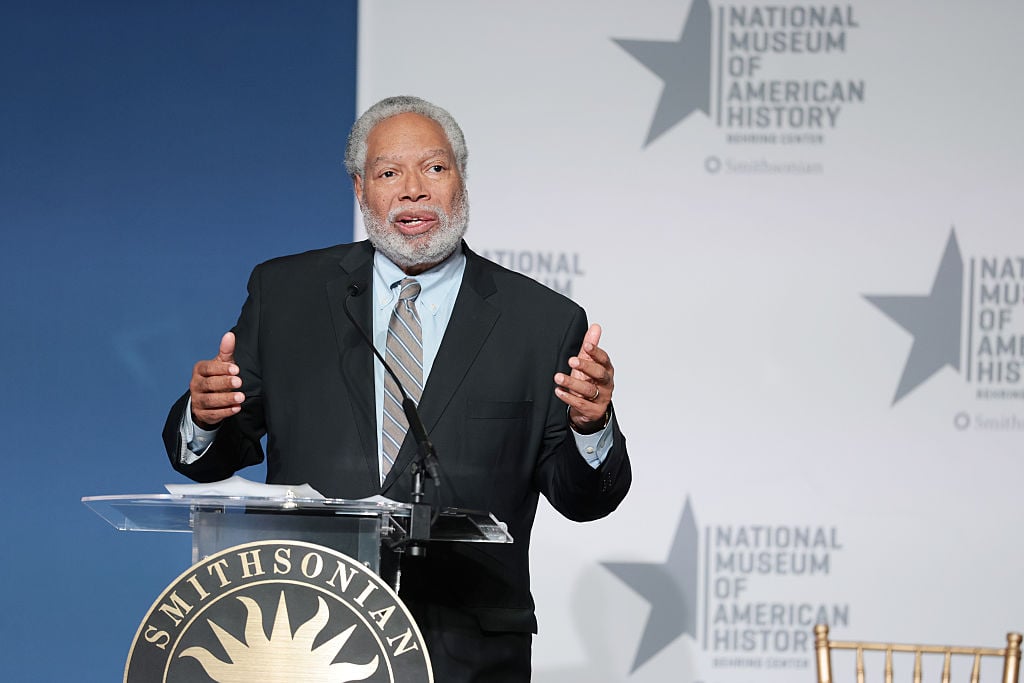
Lonnie Bunch is stepping down as leader of the Smithsonian after 7 years atop the institution. Bunch’s resignation comes after intense criticism from the Trump administration, which has attempted to whitewash American history while accusing institutions like the Smithsonian of promoting ideologies at odds with Trump’s right-wing social views.
Bunch steps down after ‘stressful’ pressure from White House
The New York Times reported Tuesday that Lonnie Bunch will step down as Secretary of the Smithsonian, a position he has held since 2019. Bunch’s resignation came after intensifying scrutiny from the Trump administration, though Bunch maintained that he wasn’t resigning because of political pressure. “It was really just saying, now’s the time,” Bunch said, while adding “I’m a fighter.” Nevertheless, Bunch said, “I have to be honest, it has been stressful.” He admitted that “at a certain point, I’d like to wake up in the morning and not look at my cellphone.” Bunch, a prominent historian, has worked within the Smithsonian institution for 40 years. He was the founding Director of the National Museum of African American History and Culture, which opened in 2016 after more than a decade of Bunch fighting and fundraising for the museum. Bunch then became the first Black Secretary of the Smithsonian, leading the museum through pivotal moments such as the 2017 white supremacist rally in Charlottesville, VA and the 2020 murder of George Floyd.
Escalating Republican pressure campaign against Smithsonian and its leaders
Bunch’s resignation comes as the president and his allies have spent most of the current Trump administration scrutinizing the Smithsonian and its leaders. As part of its larger efforts to whitewash American history, the Trump administration launched ideologically based reviews of Smithsonian content and potentially removed exhibits on issues such as slavery and race. In 2026, the White House issued a report and an executive order highly critical of the Smithsonian and its leadership, claiming that “ideological capture” of the Smithsonian had occurred. In July, Republicans heavily criticized the Smithsonian and its leaders during what Democratic Rep. Jasmine Crockett of Texas described as a “white pride rally disguised as a congressional hearing.”
Choosing the next Smithsonian leader under the Trump administration
Bunch’s resignation came after the White House sent a letter on August 28, recently made public, in which it heavily criticized the leadership of the Smithsonian and threatened to withhold federal cooperation with the institution. Although the Smithsonian is a public-private institution that is not formally a part of the government, the federal government provides most of its funding as well as significant support for various activities of the Smithsonian and its museums. The White House letter threatened this cooperation, stating that “executive departments and agencies cannot in good conscience continue to support the Smithsonian under current leadership by, for example, loaning artifacts for exhibits, enabling procurement processes and making discretionary grants.” With Bunch stepping down, choosing his replacement falls to a 17-person Board of Regents, chaired by Supreme Court Chief Justice John Roberts, who praised Bunch as someone who “pursued excellence in the telling of our nation’s story” and led the Smithsonian with “wisdom, vision and leadership.” The board also includes Vice President JD Vance, nine civilians and a bipartisan delegation of six members of Congress. Three of the civilian positions are currently vacant and have been left open by the Trump administration.
With mounting pressure on the Smithsonian to bend to the White House’s ideological will, the leader of the United States’ most prominent museum system is stepping aside, and it is likely that the Trump administration will seek to replace Bunch with someone who aligns with its far-right vision of American history. Bunch’s resignation brings to an end a distinguished and consequential decades-long career at the Smithsonian, and it potentially sets up a moment for the Trump administration to impose its far-right view of history and society on the institution.