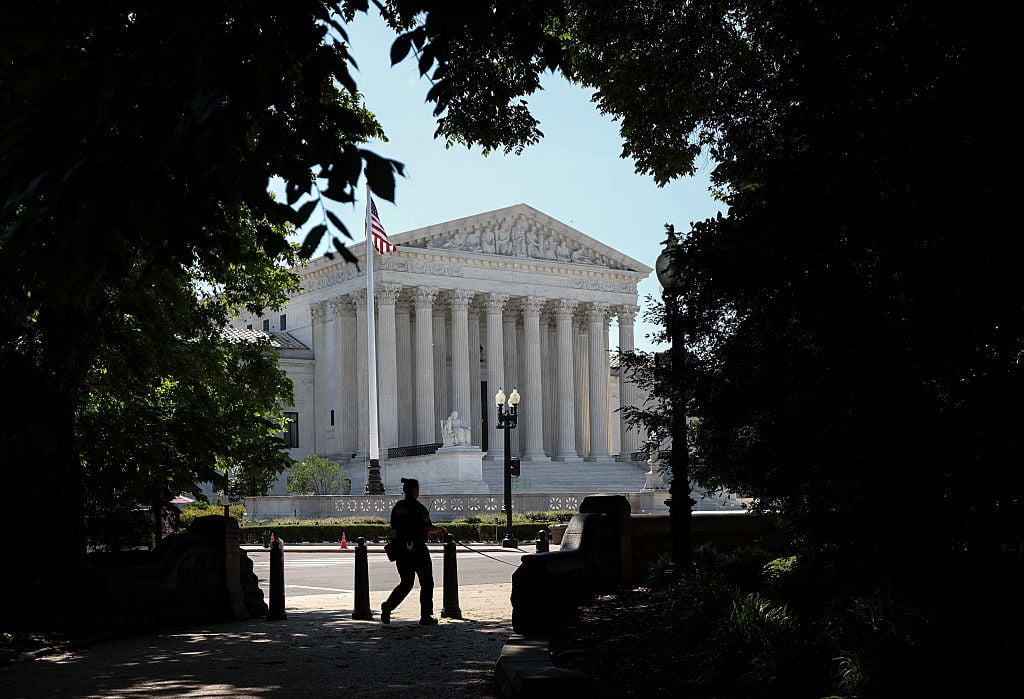
Weeks after the Supreme Court gutted the Voting Rights Act, the fallout of that decision continues to be felt as Republican-controlled states quickly eliminate predominantly Black voting districts. Now, the Supreme Court has issued another ruling in an Alabama case that allows the state to implement a congressional map that was already ruled to be racially biased against Black voters. In doing so, the court has all but eliminated the ability of courts to fight against racial gerrymandering.
Supreme Court allows Alabama map that it previously ruled was discriminatory
On Tuesday, the Supreme Court issued a ruling that allows Alabama to implement a new congressional district map that eliminates one of the state’s two predominantly Black and Democratic districts. The ruling will likely shift the state’s congressional delegation from a 5-2 Republican advantage in the U.S. House to a 6-1 Republican advantage by carving up the district currently represented by Rep. Shomari Figures.
The decision ends a yearslong fight over redistricting in the state, encapsulated in the case Allen v. Milligan. In 2023, the Supreme Court ruled that a Republican-drawn map that limited the state to only one predominantly Black congressional district likely violated the Voting Rights Act of 1965 by unfairly diluting Black voting power. After the state defiantly drew a revised map that still had only one Black district, a federal court rejected that map and redrew it to create a second predominantly Black voting district.
After the Supreme Court’s April ruling in Louisiana v Callais gutted the Voting Rights Act, Alabama appealed to reinstate its 2023 Republican-drawn map. The same federal panel of judges that previously rejected that map did so again in May.
“These events, along with legislators’ contemporaneous statements about race, support only one inference: the purpose of the 2023 Plan was to distribute Black voters across districts to dilute their votes, at least in part because they are Black,” the judges held.
Nonetheless, the Supreme Court has now pushed aside that finding. In its unsigned order Tuesday, the Supreme Court said that the federal panel “did not heed the presumption of legislative good faith” when it ruled that the Alabama GOP map had been drawn with “discriminatory animus.”
The Supreme Court’s Tuesday ruling contradicts its own 2023 ruling, in which Chief Justice John Roberts and Justice Brett Kavanaugh sided with the liberal justices to rule that Alabama’s Republican map violated Black voting rights.
Liberal justices, experts warn that the Supreme Court has endorsed racism
The court’s three liberal justices dissented from the ruling, calling out their colleagues for a decision that will entrench racial bias and electoral chaos.
“Before the Court are two paths. Down one lies an orderly election, held under a tried-and-tested congressional map that protects Black Alabamians’ right to vote and with which all voters, elections officials, and candidates alike are familiar,” wrote Justice Sonia Sotomayor on behalf of herself and Justices Elena Kagan and Ketanji Brown Jackson.
“Down the other lies a chaotic election, held under a never-before-used congressional map that intentionally discriminates against Black Alabamians, that Alabama adopted in unashamed defiance of a prior court order directly affirmed by this Court, and that will require officials to change the voter registrations of hundreds of thousands of voters in just days at best, a task that Alabama previously represented would take months.”
The ruling reinforces the racial gerrymandering that began after the Callais ruling, as Republican-led states raced to dilute Black voting power and eliminate predominantly Black districts. Republicans have claimed that this redistricting is based on political party and not race, and experts fear that the court’s Alabama ruling makes it virtually impossible to challenge race-based redistricting.
“The Supreme Court’s decision gives cover to Alabama and others to deliberately and openly discriminate against Black voters without fear of any consequence,” said Deuel Ross of the NAACP Legal Defense Fund. “The Court’s shameless decision to reinstate an intentionally racially discriminatory map defies any thoughtful or consistent application of the law.”
Building upon the Callais ruling, the Supreme Court’s decision in the Alabama case further guts the power of the Voting Rights Act to protect Black voting power. Republican governments have now been essentially given a green light to eliminate predominantly Black voting districts and dilute Black voting power, a move that is expected to have major impacts on Black representation and political power.