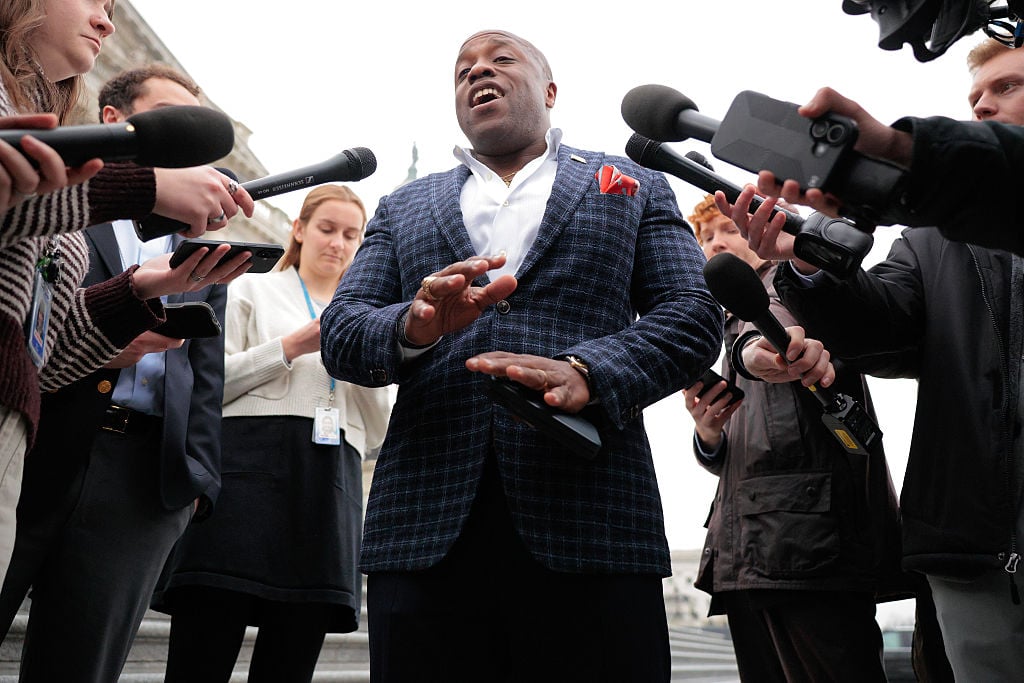
A Black congressional Republican has gone viral for dismissing the fact that the GOP will soon not have any Black representatives in the House of Representatives. This decline in Black GOP representation comes alongside active efforts by Republicans to push Black Democrats out of the House as well.
Texas Rep. Wesley Hunt dismisses the drop in Black Republican representation
An exchange between MeidasTouch reporter Pablo Manríquez and Texas Rep. Wesley Hunt is going viral. In the clip on the steps of the Capitol, Manriquez says, “There’s been a lot of talk how there won’t be any Black Republican members in the new term. What do you make of that?”
Hunt takes umbrage with the question, saying, “I don’t understand how that’s relevant,” and declaring, “I’m not here because I’m Black. I am here because I’m qualified — representative for Congressional District 38, and the American people choose who they want to choose. And the one thing I don’t want to get into is this game of race-bait all day, every day.”
Hunt declared that he represents a majority-white district and paraphrased Martin Luther King Jr., saying, “I am being judged not by the color of my skin but by the content of my character. I don’t care how many Black people are here. I want the most qualified people here.”
Hunt later responded to the viral clip, posting on X, formerly Twitter, “Here’s how you flip a ‘gotcha’ question on race into reality:
Americans don’t want quotas.
They don’t want optics.
They want results.”
GOP gains with Black voters not matched by electoral success for Black candidates
The exchange with Hunt illustrates the shifting nature of Black congressional representation, with the House of Representatives poised to lose all of its Black Republican members in 2027. As Blavity reported, Hunt is one of five Black Republicans in Congress, alongside Reps. James John of Michigan, Byron Donalds of Florida, Burgess Owens of Utah and Sen. Tim Scott of South Carolina. Hunt recently lost his bid to replace Texas Sen. John Cornyn in that state’s Republican primary. John is currently running for governor of Michigan, and Donalds is leading other Republicans in the race to become the next governor of Florida despite racist attacks from at least one fellow GOP candidate. Owens announced his retirement after a redistricting effort in Utah significantly boosted Democrats’ chances of flipping one of the state’s four congressional districts.
The exit of all Black Republicans from the House comes despite CNN’s Harry Enten recently reporting on X that President Donald Trump and Republicans are “holding on to the generational gains they made with Black voters in the 2024 election.”
Enten noted that the party ID advantage that Democrats have over Republicans has dropped to a 51-point advantage, down from a 62-point advantage at this point in Trump’s first term. Black approval for Trump, meanwhile, currently sits at 16% compared to 12% during this point in his first presidency.
Conservatives seek to eliminate majority-Black districts
While notable statistically, Black support for Trump and the GOP remains low in absolute terms, and Republican inroads among Black voters haven’t translated into gains in Black GOP representation. While most of the current Black congressional Republican delegation is set to leave office next year, the GOP has had little success running candidates such as Herschel Walker’s Georgia senatorial campaign in 2022. Meanwhile, the number of Black Democrats in the House may also decline soon and precipitously. Since the president kicked off a wave of partisan redistricting by calling on GOP-controlled states to redraw their congressional maps, states such as Texas have gerrymandered districts, partially along racial lines, as part of the larger effort to eliminate Democratic seats. Although Democratic-controlled states like California and Virginia have countered with their own redistricting efforts, the net effect of this process for Black congressional members remains to be seen. The Supreme Court struck a more direct blow to Black representation when it severely weakened the Voting Rights Act of 1965 and set off a process by which Republican-controlled states in the South are already moving to redraw lines to eliminate majority-Black districts.