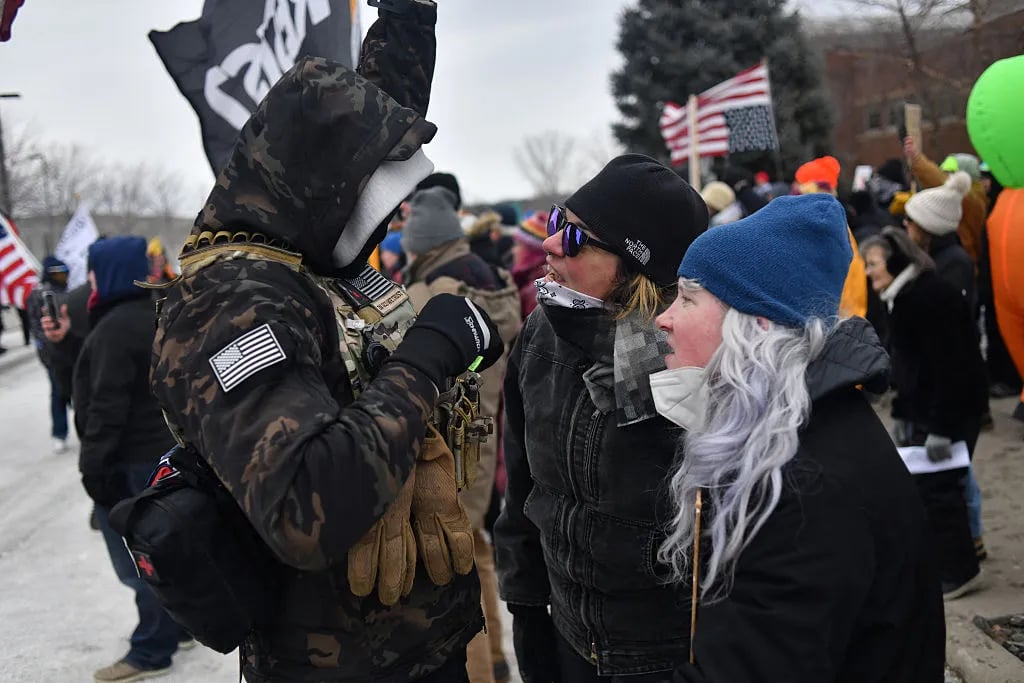
As the Trump administration faces protests and backlash concerning its ongoing immigration enforcement intervention in Minnesota, the president is doubling down on the effort. He’s now threatening to invoke the rarely-used Insurrection Act to broaden his powers in Minnesota, even as leaders in the state push back against the federal incursion.
Trump threatens to use the Insurrection Act as opposition to ICE in Minnesota continues
“If the corrupt politicians of Minnesota don’t obey the law and stop the professional agitators and insurrectionists from attacking the Patriots of I.C.E., who are only trying to do their job, I will institute the INSURRECTION ACT,” President Donald Trump wrote in a social media post. Trump has suggested on multiple occasions during his current term that he might invoke the Insurrection Act, an 1807 law that allows the president to use the military for domestic purposes under certain conditions. The rarely used act has been invoked by past presidents to fight the KKK after the Civil War, enforce desegregation in the American South, and, most recently, in 1992, to deal with the LA riots. In Thursday’s social media post, Trump claimed that invoking this law is something “which many Presidents have done before me,” and he said that his use of the act in Minnesota would “quickly put an end to the travesty that is taking place in that once great State.”
Trump’s threat comes as people in Minnesota and throughout the country continue to criticize or protect the wide-scale Immigration and Customs Enforcement operation that has been going on in Minnesota this month. The heavy-handed and violent tactics of ICE have drawn heavy condemnation, particularly concerning the shooting death of Renee Good at the hands of an ICE agent earlier in January. The Trump administration continues to defend Good’s killing and the immigration crackdown in general. On Wednesday, an ICE agent shot a man in the leg during another immigration raid. These shootings have happened as nearly 3,000 federal immigration officers in Minnesota continue what Trump has described as the largest operation in the history of the Department of Homeland Security.
Aggressive tactics and local pushback as Trump pushes immigration agenda
Trump’s threat to use the Insurrection Act and his attack against “corrupt politicians of Minnesota” reflect significant state and local opposition to the ICE operation in the state. After the Wednesday shooting, Minneapolis Mayor Jacob Frey said the ICE operation “is not sustainable” and declared that “we have ICE agents throughout our city and throughout our state who along with Border Patrol are creating chaos.” Minnesota Gov. Tim Walz addressed Minnesotans’ anger after the latest shooting and called for peace. “What Donald Trump wants is violence in the streets,” Walz wrote, “But Minnesota will remain an island of decency, of justice, of community, and of peace. Don’t give him what he wants.”
The intervention in Minnesota is the latest example of the militarized and often violent approach to immigration enforcement taken by Trump during his current term. Trump has sent National Guard and other federal troops into a number of cities, including Washington, D.C., Los Angeles and Chicago, with the stated purposes of fighting crime and enforcing immigration laws. The interventions into Democratic-led cities has provoked significant pushback from local and state-level officials. In 2025, a federal judge limited Trump’s use of federal troops in Los Angeles, saying the president did not have the authority to create a “national police force.” Minnesota Attorney General Keith Ellison, along with Frey and St. Paul Mayor Kaohly Her, have launched “a joint lawsuit to end the unlawful and unprecedented surge of ICE agents in Minnesota.”
The situation in Minnesota remains volatile and dangerous. With Minnesota officials suing to end the ICE intervention in the state and Trump threatening to use the Insurrection Act to escalate the operation, the legal and political fights over the federal intervention are poised to continue.