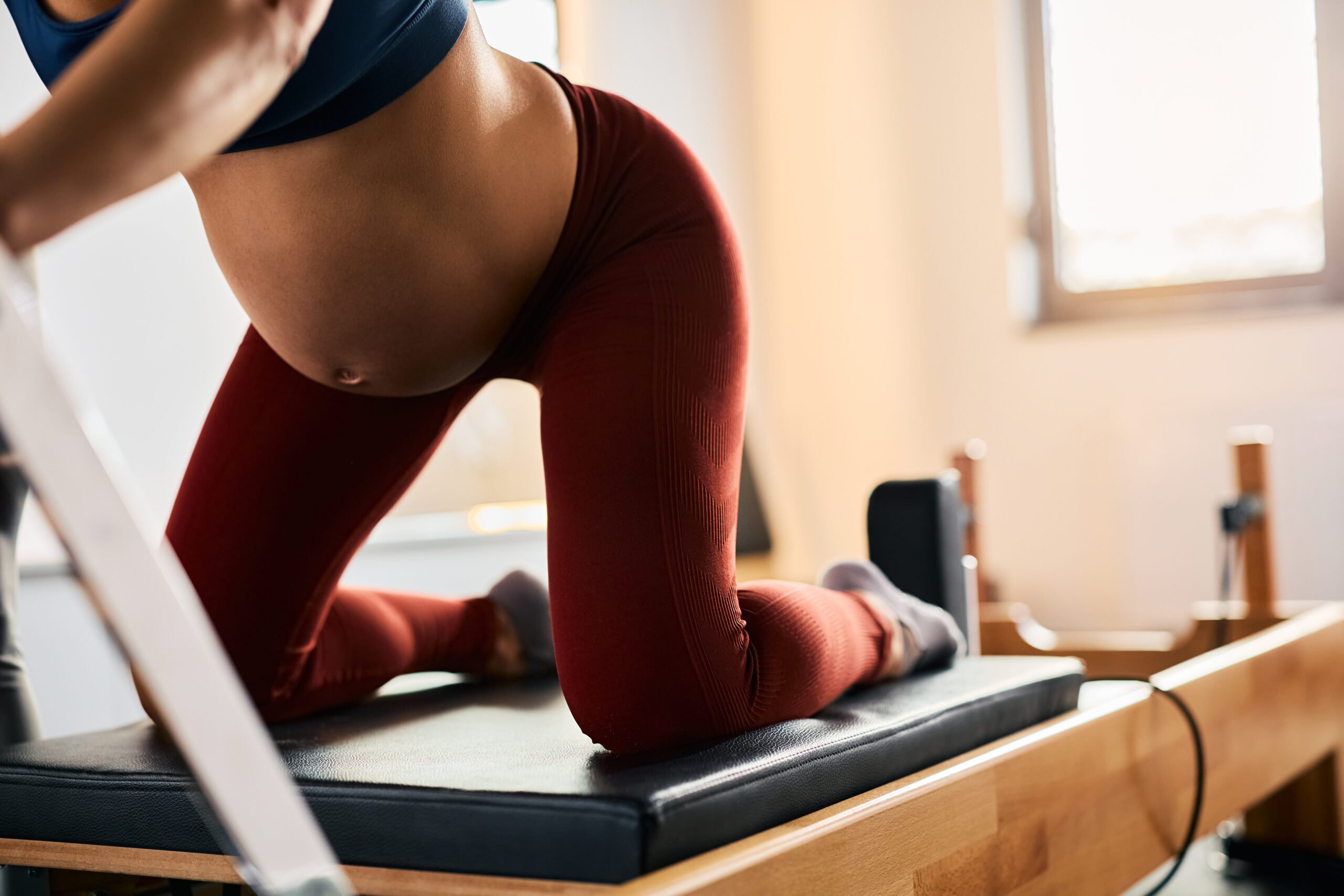
Even for the mothers who have given birth before, going into labor and delivery can always be a terrifying experience. No matter how common, childbirth is risky with the potential for complications . This is especially true for Black mothers, who tend to be the most neglected in the medical practice.
Though everyone’s birthing experience is different, there are plenty of natural methods that can seemingly help labor go as smoothly as possible. From raspberry leaf tea and dates to curb walking, many mothers swear by their tried and true pregnancy secrets. But one particular movement modality is making waves when it comes to its pregnancy and delivery benefits, and that’s pilates.
Pilates and Delivery
Pilates isn’t just for washboard abs and toned legs. Studies have concluded that practicing pilates during pregnancy can significantly reduce labor pain intensity and length of labor. The potential benefits for practicing pilates consistently before giving birth are upheld through the knowledge that pilates:
- Brings your awareness to your core
- Aids in stamina
- Improves your pelvic mobility
- Enhances your concentration
- Focuses your control through breath
- Assists in relaxing the pelvic floor
But can prenatal pilates truly make a difference during delivery, or is it all placebo? To get a clearer understanding, 21Ninety got a chance to connect with Pilates instructor, Nike Well Collective Trainer, and wellness entrepreneur Coach Zha to dive deeper into how pilates can transform the pregnancy, labor, and postpartum experience, as well as how its deep roots trace back to Black women.
Transforming Childbirth with Pilates
21NINETY: First and foremost, I’d love to know your story and how you came into Pilates as a profession.
COACH ZHA: Motherhood is absolutely the reason I found Pilates. Had it not been for my transition from womanhood to motherhood, I would have never even explored what Pilates was. I was a marathon runner prior to becoming a Pilates instructor, and I am absolutely in love with every single thing that I do each and every single day. My background is in corporate but once I became a mom, time felt different. It stood still in a way that I wanted to show up more intentionally for my son at the time, now I have two kids, with the ability of being able to have more emotional, physical and spiritual availability for them. That comes as a result of me being able to show up in an industry that allows me to fill up my cup so I can be full for my children. I found Pilates during postpartum depression. I was completely lost, I didn’t know who I was. I was looking for a way to find myself again.
I always say there’s these seismic changes that happen during your life, and during those transitions, it is really important to either surround yourself with community or give yourself an opportunity to explore something different to just release yourself into. I’m so grateful that for that moment, I had Pilates to save me, and it changed my life in all of the most beautiful ways. I felt like I was a different woman. I felt capable again, I felt strong again, and I felt like I was able to find myself in a new way.
I personally am not a fan of the term bounce back, because I don’t think any woman is the same after motherhood. I think you are so much stronger as a result of you carrying a child, delivering a child, and having to raise a child, while also raising yourself through this new transition. Pilates was an opportunity for me to find myself in ways that I needed. I thought that somebody was going to come in and save me, when I was the person that came in and saved myself. So there’s a very soft space that I have in my heart for wellness, for Pilates, for community, but for the ability to be able to get my body, my mind and my spirit to a place that it has never been before, even stronger than I had ever imagined. I wanted every woman, specifically black mothers, to know that this modality existed specifically to help us repair our pelvic floor, to help us with breath work, to help us calm our nervous systems, so that we had an outlet to be able to save us, maybe during the times that we felt like we needed something from someone, when at all times, it is always us that comes in and saves the day for our own well being.
Pilates has been a safe space, a saving grace, and it has created community for me with black mothers, black women, and people from all walks of life that have been so open to this concept of just trying something new. As a result, I’ve been able to impact so many people, and I’m just so grateful for the opportunity of seeing what was on the other side. I met myself at that intersection of curiosity and exploration, and I haven’t looked back since. I now have two children, and my second time around was a lot different than my first as a result of Pilates. So I’m in a state of continuous gratitude as a result of Pilates.
21NINETY: How did Pilates played differentiate your first go around giving birth versus your second?
COACH ZHA: I think in totality, movement has a very beautiful way of being able to really come in a woman’s life, especially during her pregnancy, to help her build strength, breath capacity and even pelvic floor awareness simultaneously, because these are all of the things that are required for labor, recovery and motherhood. My second time around, I had so much more in my wellness toolkit to be able to access that I didn’t necessarily have the first time around. I wasn’t scared. I wasn’t in a state of the fear of the unknown of what could happen to my body. I knew everything that was coming, so I was preparing myself for it. I always tell my friends who are getting ready to have children and conceiving, how you treat your body before you get pregnant is how your body will treat you during pregnancy, and how you treat your body during pregnancy is how your body will treat you postpartum. So with the knowledge that I had from my first experience, I told myself to continuously show up for myself, to continue to be the safe space that I needed, and to continue to pour into my body, because my body needed me in order for me to be able to deliver at the speed in which I needed to, and to recover at the speed in which I needed to.
The second time around, I just had so much more information. I had so much more awareness, and I was so much more comfortable in my body and so much more receptive of change, knowing that on the other side of it only beautiful things were to come. There wasn’t this idea that I’ll never see myself again. I don’t know who I am. There was nothing but excitement the second time around. The entire journey was one of the most beautiful experiences I have ever had in my entire life as a result of now trusting myself more than I have ever trusted myself before.
21NINETY: Do you feel like Pilates afforded you a mind-body connection that you didn’t have before, that allowed the delivery process to be so ideal?
COACH ZHA: A term that we use in Pilates is mind to muscle connection. Being able to get out of your head and stay in your body, we are all capable. I strongly believe in the ethos that Nike has around if you have a body, you’re an athlete. That’s how I looked at myself throughout my entire pregnancy, and what was able to happen during labor and delivery for the first time in the second time. With my son, I was a runner, but with my daughter, I had so much more awareness on my pelvic floor, I was able to deliver my daughter, I kid you not, in 22 minutes. I pushed for a total of three pushes, and she was out. It was so incredible for me, because I now knew how to connect with my body from the inside. There wasn’t this idea of panic. I knew how to trust my body. I knew exactly what my body reacted to. The energy in the room was different, the music that we played was different, the trust that I had with my doctors and my team so different. It was as a result of how I showed up through each and every single doctor’s visit, through each and every single time my OBGYN came into the office.
My doctor’s appointments were 15 minutes at most, and I highly contribute that to the amount of activity that I stayed in throughout my entire pregnancy. I changed nothing when I found out I was pregnant. I only ramped it up even more. Not just for the physical component, Pilates is so much more for me than physical. The aesthetics is down the list. It is emotional and spiritual awareness that you have in your body as a result of doing something that you thought you weren’t capable of, and then being able to turn around and do it so beautifully.
Being able to create incredible community around it, and then having a village that not only lifts you up as you climbs, but that you can also uplift on their way up. It is so much more than wearing a cute set to class. It is the ability to be able to withstand 24, 48 hours of no sleep when your children are sick, knowing deep down inside you have the strength to sustain. It is the nights that feel like they’re blending in with the days. It is the moments that you feel like you don’t know how you’re going to get to the next part, but you remember what you were capable of in class earlier that week. It is one of the most transformative experiences I have ever encountered in my life, and as a result of it, I will make it my mission to make sure as many Black women, specifically Black mothers, are aware that this exists for us. Because I strongly believe, as a result of it, I am the mother I am today.
21NINETY: To the black women who are apprehensive about venturing into Pilates, what would you say?
COACH ZHA: I’m so happy you asked this question. A lot of us don’t know how deeply rooted we are in this practice. I am so honored to be able to speak on this. We have an ancestor by the name of Catherine Stanford Grant, who was one of Joseph Pilates’ first apprentices. She was directly certified underneath him. She was a dancer and helped to popularize this modality in New York City when Joseph Pilates brought it to the states in the 1920s and as a result of her legacy, we were able to spread this awareness to the dancers of the Dance Theater of Harlem and so much further beyond. Her legacy lived still lives on to this day. What I always tell my community is that anytime you walk into a space, a boutique fitness center, or a boutique class, or a Pilates experience, where you may be the only person that looks like you, remember that your ancestors are the reason that this modality is as big as it is. That our history is deeply rooted in this practice. I stand 10 toes down in every room that I’m in, up in the front, making sure that I take up space. I am here to positively disrupt Pilates in the best ways.
My mission is to make sure there is no Black woman that ever comes to Pilates and feels like she does not belong. As a result, we create communities, we create experiences and activations specifically for Black women. Tomorrow, I have an event called Love Letters to Black Women. This will be our third iteration of this activation, and it is specifically to pour into Black women through Pilates. I’m intentionally doing it on the last day of Black History Month, to always remind Black residents how important it is to always take up space, especially in Pilates. I am about not only spreading the beautiful history of it, but making sure that a Black mother, a Black woman, a Black sister, a Black caregiver, is able to come into this space and know that you are needed, you are one, and you are so loved and so appreciated in this space. Let it transform you in the most amazing ways.
My only regret is that I didn’t find it sooner, that I couldn’t spread awareness about it even sooner. But I think everything happens for a reason, and as a result of finding when I did, it hit so hard. There are so many Black instructors on the rise across the nation who are entering to these spaces for the same reason. I’m really excited for the future of Pilates, especially for Black women.
21NINETY: With that, are there any specific movements that you in particular recommend to make labor more bearable at all?
COACH ZHA: From a classical Pilates standpoint, there are so many different routines and exercises that you can do to strengthen your pelvic floor, especially the 100. It’s really testing your breath connection to your body, being able to really touch your core control and stay rooted in your pelvic floor. The first thing that I always say is get your belly button close to your spine, remove the space between your back and your mat and really sink into it. That alone starts to engage your transverse abdominis muscle that helps to support your spinal engagement. What happens in that moment is, as a result of you flattening out your back, you’re now allowing yourself to utilize your abdominals in the correct way. When women come to class and tell me they don’t typically feel it, it’s because the form isn’t correct. So once you’re able, especially pregnant and prenatal Pilates, to get your form right, it’ll be incredible for you to be able to sustain it.
For me, consistency is the biggest thing for prenatal Pilates. Everything that we do in Pilates is rooted in pelvic and spinal mobility. So the entire choreography, from the start to the finish, from the 100 to the push up series, are going to help you in totality. But it’s not just going in one class. It’s the routine of repeating it and allowing yourself to associate your time with memory and your location with energy, so that your nervous system feels comfortable in this practice. What will happen after one month, three months, six months, nine months down the line, when you’re ready to deliver baby, you’re going to have a confidence with you that is going to help you in labor and delivery.
We think it’s more physical than mental, when really it’s the mental component that will help you with being able to have the labor and delivery that so many of us dream of. It’s the mind and muscle connection that you develop. Everything that Joseph Pilates created is incredible for women to be able to practice from a prenatal standpoint, with the exception of obliques, but it’s less about specific exercises and more about the consistency in which you can do these exercises that is going to be what helps women the most. It wasn’t that I went to one class during my pregnancy. I showed up five to six days out of the week and gave myself an opportunity to pour into me that confidence carried me throughout my entire label labor and delivery journey.
21NINETY: Last question, how can people connect with you?
COACH ZHA: I am based in Philly, but I do travel to New York, Chicago, Atlanta and Los Angeles for different pop ups. If you follow me on Instagram and on Tiktok @coachzha, you’ll be able to find out all that I’m doing. We’ll also be going to Greece this year for our retreat to bring pilates, sisterhood and community to an international level and remind women of what’s possible when you come together, and how capable we are and how deserving we are of all things beautiful, especially Black women.