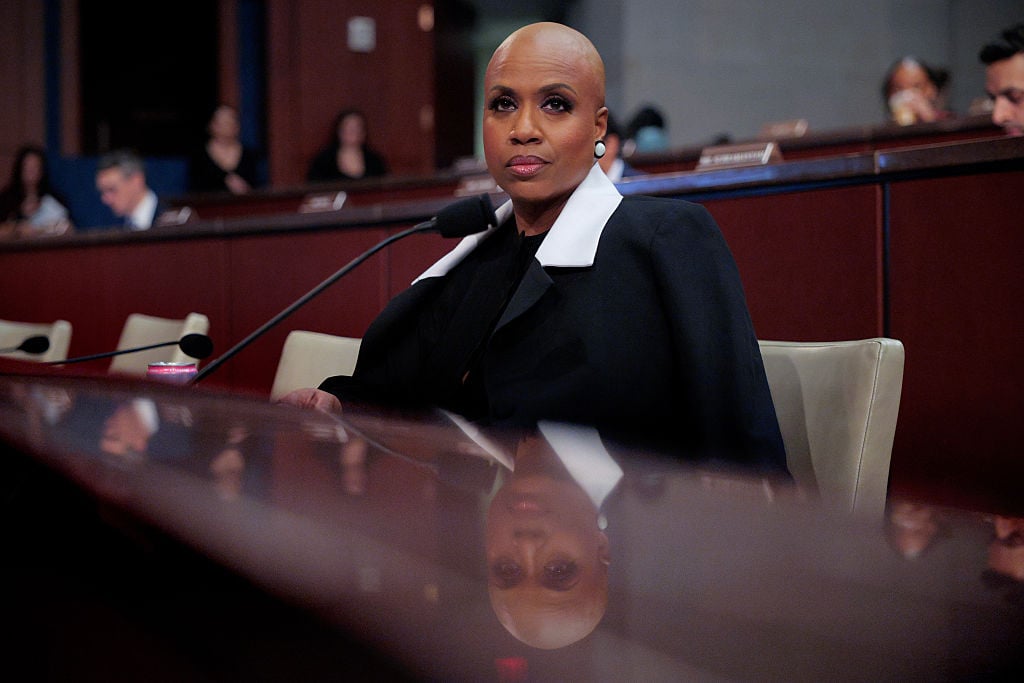
Treasury Secretary Scott Bessent appeared before Congress on Feb. 4 and 5, amid lingering criticism of the Trump administration’s economic policies. While there, Rep. Ayanna Pressley, D-Mass., interrogated Bessent on the issue of Black unemployment, and she pressed the secretary to address the extra costs that tariffs are imposing on parents of small children.
Pressley gives Bessent one month to report on Black unemployment
During Bessent’s appearance in front of the House Financial Services Committee, Pressley questioned his knowledge of the unemployment gap between Black and non-Black workers. While Bessent acknowledged that he was aware that Black unemployment was “traditionally higher than for all workers,” Pressley gave the secretary insights into the size of the problem.
“Hundreds of thousands of Black workers that have been pushed out of the workforce, and the unemployment rates for Black workers and all workers are among the highest they’ve been since the COVID-19 pandemic,” Pressley stated. She also gave statistics that “Black workers contribute over a trillion dollars to the U.S. economy, but the pushout of these workers from the workforce has led to a loss of $37 billion in the GDP.” At Pressley’s urging that Bessent “commit to analyzing Black unemployment rates specifically and its impacts on financial stability,” Bessent aggreed to do so. With Bessent unwilling to “commit to a date” to complete such a report, Pressely set a date — March 6 — for the secretary to deliver it.
@reppressley Black unemployment rates are through the roof. The pushout of Black workers has led to a loss of $37B in the GDP. Sec. Bessent: analyze this, report the findings, & take action NOW. This harm is coming for everyone if you don't.
♬ original sound – Rep. Pressley
Pressley pushes Bessent and the Trump administration to ease tariffs on baby products
During another portion of her questioning of Bessent, Pressley followed up on an earlier point of contention, calling out the tariffs President Donald Trump imposed for driving up the costs of baby products such as car seats.
Pressley’s office noted, “Nine months ago, following Rep. Pressley’s questioning, Secretary Bessent conceded the Treasury Department would consider exempting essential baby care products from tariffs, which was later reaffirmed by President Trump.”
Having seen little movement on that issue, Pressley again confronted Bessent on the costs to parents arising from the Trump tariffs during his appearance, stating, “Essential products like car seats are more expensive because of Trump tariffs,” and pointing out, “There is still no exemption for tariffs on baby products.” She also noted that other products, including asbestos, had received tariff exemptions. Rejecting Bessent’s attempts to justify the delay, telling him “parents with newborns don’t want to hear your excuses,” Pressley got the secretary to commit to advocating for the tariff exemption for baby products.
Continuing economic struggles, public dissatisfaction surrounding Trump’s economic policies
The tough questioning by Pressley comes as polling shows that most Americans remain unhappy with the economy one year into Trump’s second presidency, with cost-of-living concerns being one of the main driving forces of discontent. A significant majority of Americans also remain unhappy with Trump’s significant tariff increases. Job growth has also been slow under Trump, with 584,000 jobs added to the American economy in 2025 in comparison to more than 2 million per year throughout President Joe Biden’s term. Inflation has slowed under Trump but remains above the Federal Reserve’s target rate of 2%. Despite the mixed numbers, Trump recently agreed that the United States was already in a “Trump economy” and stated that he was “very proud of it” after previously blaming the Biden administration, rather than his own policies, for economic woes.
As Pressley made clear when she questioned Bessent, many Americans don’t see the policies that he and Trump have enacted as reasons to be proud. On the contrary, Black workers and parents of young children remain disproportionately impacted by poor economic conditions and the fallout of policies put in place by the Trump administration. Now, at Pressley’s urging, Bessent has committed to examining the continued employment gap that Black workers face and to pushing the Trump administration to ease the tariff-related costs that parents are having to absorb.