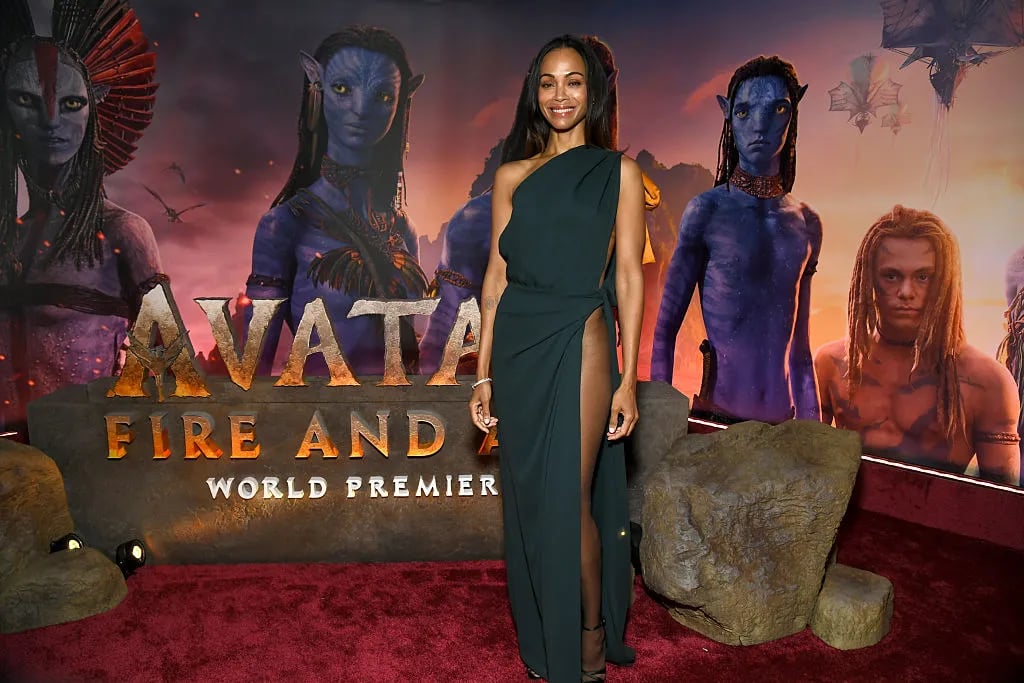
Zoe Saldaña doesn’t hold back when describing Neytiri’s emotional state in the upcoming Avatar: Fire and Ash, and she doesn’t soften the blow for audiences either. In the latest installment of James Cameron’s epic franchise, Neytiri is consumed by grief after the loss of one of her children in the previous film, and it is a journey that demanded an intense, emotionally vulnerable performance from Saldaña.
“She was intense. She was feeling a lot of intense emotions,” Saldaña told Blavity’s Shadow and Act during our recent cst interview. “Experiencing the unimaginable tragedy of losing a child is something that no parent ever wants to even talk about. It’s unfathomable. And as a consequence, as a result of that, she’s given up. Man, she’s like a full-blown racist. And she’s so blinded by rage that she’s almost unrecognizable to Jake.”
Even Neytiri’s partner, Jake Sully (Sam Worthington), can’t reach her — until their children begin the process of healing both parents. “He knows that this is not who she is,” she said. “And it’s not until the Sully children begin to heal her and begin to heal Jake as well that they realize, ‘Oh, my God, this family is our fortress. We can do this.’”
Saldaña praised Cameron for not sugarcoating that emotional weight. “I think that Jim did not want to shy away from just all the heavy burdens that they were feeling in their bodies and their lives.”
Zoe Saldaña On James Cameron’s Anti-AI Stance
Beyond Neytiri’s arc, Fire and Ash also grapples with real-world themes — including the unchecked rise of artificial intelligence. Cameron opens the film with a pointed message about distinguishing between helpful and harmful tech, something Saldaña believes we need to take seriously.
“We’ll begin to witness it the more and more people begin to use it when it doesn’t work, because there’s no connection,” she said. “We as human beings, yes, we want to be fed things fast. We’re living in an era where instant gratification, 30 seconds or less, and that’s causing us to become so impatient with each other. We’re so impatient. If we don’t get it now and we don’t get it fast, we don’t want it.”
That urgency stands in sharp contrast to how Avatar was made. Saldaña pointed out that Cameron’s refusal to rely on generative AI meant the story had to be crafted with intention and care — not shortcuts.
“I think that Avatar presented a challenge for Jim, because this movie requires time, and it requires patience, and it requires love in order for you to be able to connect with it,” she said. “And what’s made this movie so special is that everybody that allows themselves to go see it, they are immediately connected.”
What AI can’t replace
While generative AI might continue to be used and abused in Hollywood, Saldaña doesn’t think it can replace the human touch.
“Yes, people will abuse, misuse and use, overuse generative AI, but those are the films that though people may go see it, they’re soulless,” she said. “So, at the end of the day, Jim did not cheat. He did not take a shortcut.”
Cameron’s choice to avoid AI wasn’t just about creative pride — it was about preserving integrity in storytelling. “He refused to work with any kind of generative AI because he wanted to respect the process,” Saldaña said. “What we were putting into this is exactly what audiences are seeing. And that takes time. So, good things are always worth the wait.”
A call for regulation
Looking ahead, Saldaña believes the conversation around AI in entertainment can’t stop with ethics — it has to be backed by legal accountability.
“I think that we should continue these conversations, and we should remain completely open, and curious so that we can reach a place of compelling our organizations to regulate it,” she said. “This needs to be regulated by law. And then all of a sudden, it will not be abused and misused.”