
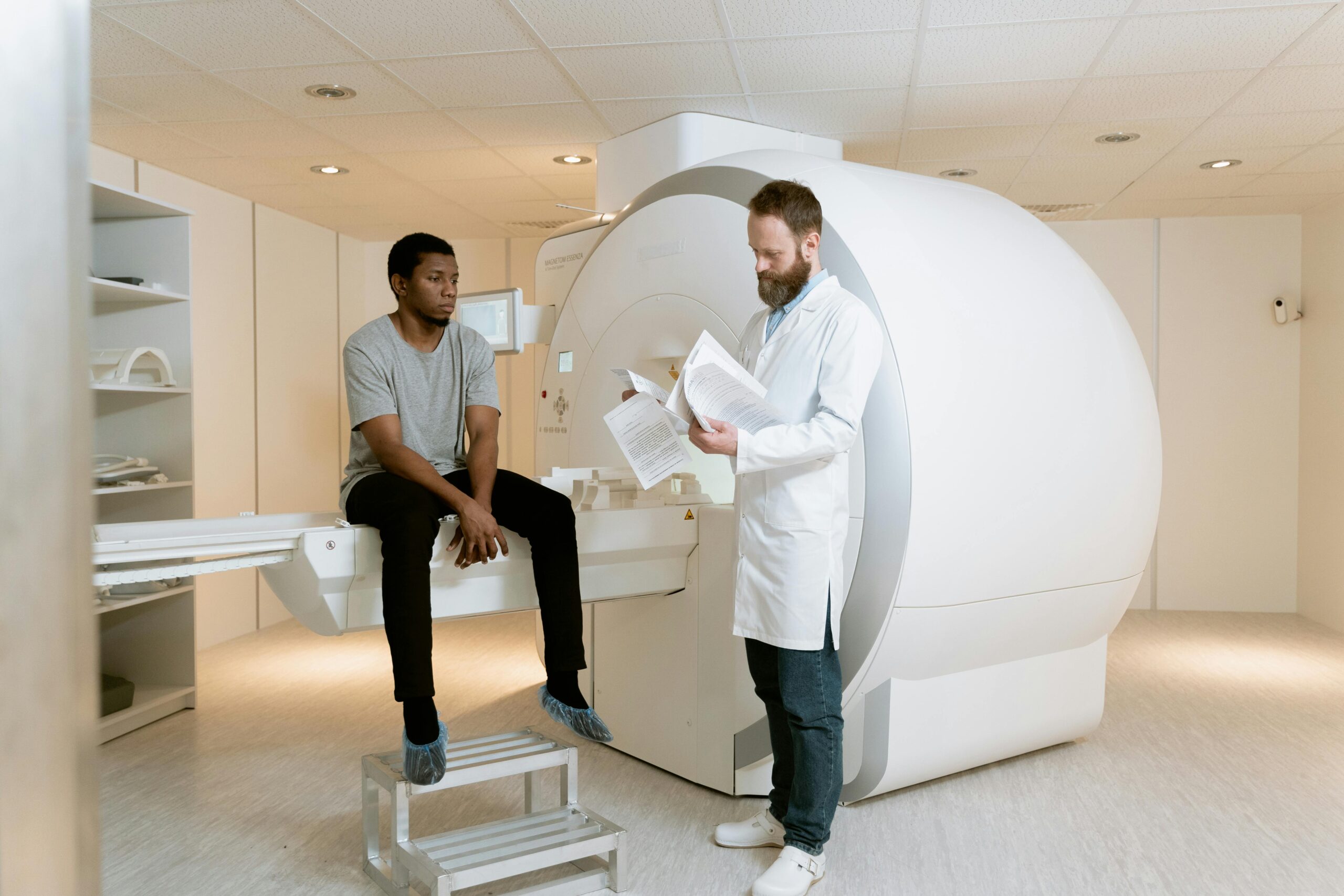
Walking into an MRI room can feel like entering a sci-fi movie. The machine is massive; it looks like a giant donut and when it starts working, it makes loud banging and clanging noises. It is natural to feel a little intimidated. Because the machine sees inside your body, many people worry about safety. We know that X-rays and CT scans use radiation, and we know that too much radiation can be dangerous. So, it is a widespread question to ask: “Does this giant magnet also put me at risk for cancer?”
You might be delaying a necessary scan because you are afraid of the side effects. It is essential to separate the myths from the medical facts so you can make the right choice for your health.
Overview
The short and simple answer is no, an MRI cannot cause cancer. Unlike X-rays or CT scans, an MRI does not use “ionizing radiation.” Ionizing radiation is the kind that damages DNA and leads to cancer. Instead, an MRI uses powerful magnets and radio waves, the same type of waves that transmit music to your car radio.
According to the National Institutes of Health (NIH), there is no known biological risk of cancer from the magnetic fields used in diagnostic MRI. It is considered one of the safest imaging tools in modern medicine.
What do claims say about MRI causing cancer?
If you search online, you might find forums or social media posts claiming that “all medical scans give you radiation.” The argument usually goes like this: Doctors limit how many CT scans you can have in a year because of cancer risk. Since an MRI is also a large scanner, people assume it has the same limitations and risks.
Some people also worry because the technology’s full name is “Magnetic Resonance Imaging.” In the past, it was sometimes called “Nuclear Magnetic Resonance.” The word “nuclear” terrifies people because they associate it with bombs or power plants.
What the science actually says
To understand why MRI is safe, you have to look at the physics. There are two main types of energy waves used in medicine:
Ionizing Radiation (High Energy): This includes X-rays, CT scans and PET scans. These waves are so powerful that they can knock electrons off atoms. If they hit your DNA, they can cause mutations. Over time, these mutations can lead to cancer.
Non-Ionizing Radiation (Low Energy): This includes MRI, ultrasound, and radio waves. These waves carry enough energy to move things (like water molecules) or to heat them slightly, but they are not strong enough to break DNA bonds.
The Mayo Clinic explains that an MRI uses a strong magnetic field to align the protons in your body. Then, a radio wave is pulsed through the body. The protons react, and when the radio wave stops, they release energy that the computer turns into a picture. At no point is your DNA under attack.
Why this misconception exists
The confusion almost always comes from mixing up MRI with CT scans. As the National Institute of Biomedical Imaging and Bioengineering explains, a CT scan (Computed Tomography) is a super-powered X-ray that rotates around your body. It exposes you to a significant amount of radiation, sometimes equivalent to hundreds of chest X-rays in a single sitting. Because the machines look somewhat similar, both are large tubes you slide into and patients often group them in their minds.
Additionally, the name’s history plays a role. As mentioned, the technology was initially based on “Nuclear Magnetic Resonance.” Scientists changed the name to MRI specifically because they knew the word “nuclear” would scare patients, even though in this context, “nuclear” referred to the “nucleus” (center) of an atom, not radioactive material.
“One of the most common myths I hear from patients is that an MRI might expose them to radiation or increase their cancer risk,” says Dr. Arthur Burnett. “I always reassure them that MRI technology does not use ionizing radiation and does not damage DNA. From a medical standpoint, MRI is one of the safest imaging tools we have. The real focus should be on proper screening for metal and implants, not cancer risk. When an MRI is recommended by your doctor, it’s because the benefits of clear, detailed imaging far outweigh any minimal safety concerns.”
The real risks
While we can breathe a sigh of relief knowing that MRIs do not cause cancer, it is still essential to understand that “safe” doesn’t mean “zero risk.” The primary safety concern stems from the machine’s magnet, which is incredibly powerful (thousands of times stronger than a standard refrigerator magnet) and remains active 24/7. This creates a “missile effect” where unsecured metal objects, such as scissors or oxygen tanks, can be pulled violently toward the machine. This magnetic force also poses a direct threat to anyone with internal medical hardware, such as pacemakers, cochlear implants or surgical brain clips, as the machine can cause these devices to shift or malfunction entirely.
Beyond the magnetic pull, the radio waves used during the scan can occasionally lead to thermal issues. In rare instances, these waves may interact with metal-based tattoo ink or medical monitoring wires, resulting in skin burns. Finally, there are specific considerations regarding the contrast dye, known as gadolinium, which is often injected to improve image clarity.
While the FDA generally considers gadolinium safe for the majority of patients, it poses a specific risk for those with severe kidney disease. In these individuals, the dye can trigger a rare but serious condition called Nephrogenic Systemic Fibrosis (NSF), which causes the skin to harden and thicken. Understanding these factors ensures you can advocate for your health and walk into your appointment fully informed.
It’s also worth noting that the MRI machine is extremely loud. The banging noise can reach 110 decibels, which is as loud as a rock concert or a jackhammer. To protect your hearing and reduce stress, always ensure the technician provides earplugs or headphones before the scan begins.
What is the most significant safety concern in MRI?
The “Projectile Effect” is the number one safety concern. Because the magnet is so strong, any ferromagnetic metal (a metal that sticks to magnets, like iron or steel) becomes dangerous. Hospitals use a strict zoning system around MRI machines to protect patients, staff and equipment from serious safety risks.
Zone 1 is the public area, such as hallways, where anyone can move freely. Zone 2 serves as the reception and screening area, where patients are checked for metal objects, implants or other safety concerns before proceeding further. Zone 3 is a restricted control area that only trained staff and properly screened individuals may enter, as it is close to the powerful magnetic field. Zone 4 is the MRI magnet room itself, where the magnetic field is strongest and constant, making it the most dangerous area.
If someone accidentally brings a wheelchair, a cleaning bucket or even a credit card into Zone 4, it can cause serious injury or damage the million-dollar machine.
Can MRI results be seen immediately?
Technically, the images appear on the computer screen the moment they are taken. The technician running the machine can see your brain, knee or spine right away. However, you will not get the results immediately. The technician is trained to operate the machine, not to diagnose diseases. They are strictly forbidden from telling you what they see.
A specialist doctor, called a radiologist, must review the images. They review hundreds of slices, compare them to your history, and write a report. According to Johns Hopkins Medicine, this process usually takes 24 to 48 hours, after which your primary doctor calls you with the news.
What not to do before an MRI
To keep your appointment safe and fast, avoid these common mistakes:
Do not wear jewelry: Leave your wedding ring, watches, earrings and necklaces at home. It saves time and prevents them from getting lost or pulled by the magnet.
Do not wear “athleisure” clothes: Many yoga pants and athletic shirts contain tiny silver or copper threads to stop sweat smells. These metallic threads can heat up in the MRI and burn you. Wear 100% cotton if possible.
Do not wear makeup: Some mascaras and eyeshadows contain iron oxide. This can mess up the images of your brain or eyes and can sometimes heat up.
Do not get a fresh tattoo: If you just got a tattoo, tell your technician. The ink might still be settling, and the skin is sensitive.
Bottom line
An MRI is a powerful and safe diagnostic tool that does not use ionizing radiation, meaning it cannot cause cancer or damage your DNA. While myths persist because of confusion with CT scans, the real risks of MRI are related to metal safety and loud noise, not radiation. You can safely undergo as many MRI scans as your doctor recommends without worrying about long-term radiation effects.
Frequently Asked Questions
How long does radiation from an MRI stay in your body?
There is zero radiation in an MRI, so nothing stays in your body; the radio waves stop existing the moment the machine is turned off.
How much does an MRI scan cost?
The price varies widely by insurance and location, but without insurance, an MRI typically costs between $400 and $3,500, depending on the body part being scanned.
Citations
Hartwig V, Giovannetti G, Vanello N, Lombardi M, Landini L, Simi S. Biological Effects and Safety in Magnetic Resonance Imaging: A Review. International Journal of Environmental Research and Public Health. 2009;6(6):1778-1798. doi:https://doi.org/10.3390/ijerph6061778
Mayo Clinic. MRI. Mayo Clinic. Published 2023. https://www.mayoclinic.org/tests-procedures/mri/about/pac-20384768
National Institute of Biomedical Imaging and Bioengineering. Computed Tomography (CT). National Institute of Biomedical Imaging and Bioengineering. Published 2022. https://www.nibib.nih.gov/science-education/science-topics/computed-tomography-ct
Research C for DE and FDA Drug Safety Communication: New warnings for using gadolinium-based contrast agents in patients with kidney dysfunction. FDA. Published online June 28, 2019. https://www.fda.gov/drugs/drug-safety-and-availability/fda-drug-safety-communication-new-warnings-using-gadolinium-based-contrast-agents-patients-kidney
Johns Hopkins Medicine. Frequently Asked Questions. Hopkinsmedicine.org. Published 2026. Accessed February 6, 2026. https://www.hopkinsmedicine.org/imaging/about-us/faq#images