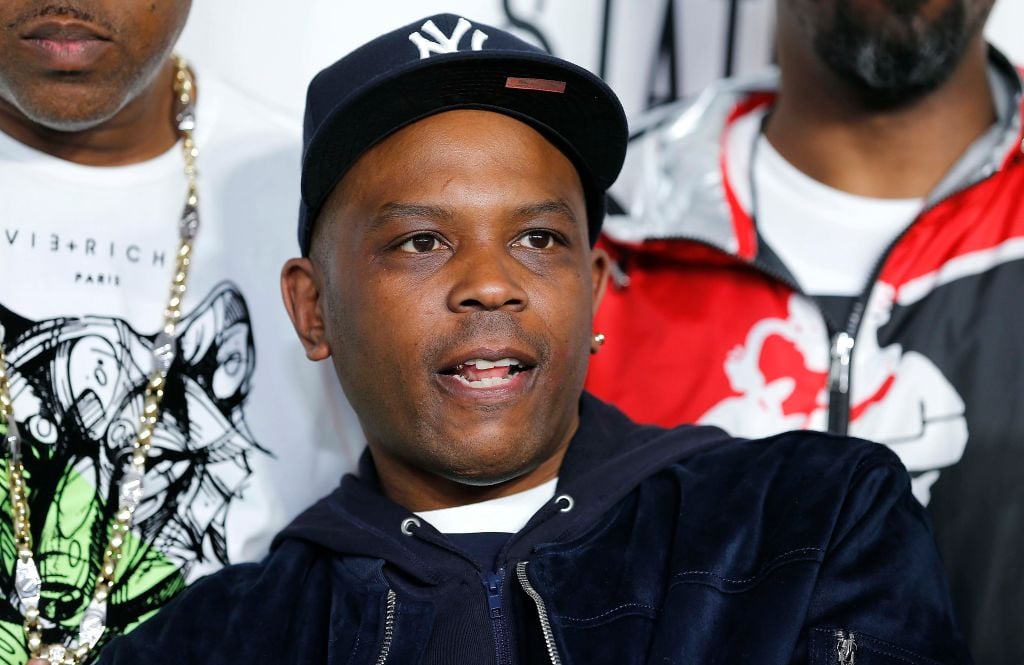
Oliver “Power” Grant, an early champion of the Wu-Tang Clan who helped shape the group’s music and business empire — including its influential Wu Wear clothing line — died Monday at 52.
According to The Guardian, Grant’s death was confirmed by Wu-Tang in a statement shared on social media. Here’s a look at his life, his legacy and how members of the iconic hip-hop collective are honoring the late entrepreneur.
Wu-Tang members Method Man, GZA, Raekwon and RZA pay tribute to Grant on social media
Wu-Tang rapper Method Man — who appeared alongside Grant in the 1998 film Belly and 1999’s Black and White, Hot 97 reported — shared a heartfelt tribute to the late entrepreneur on social media.
“Paradise my Brother safe Travels!! 💔💔🤬 #pookie #power Bruh I am not ok .. 🌧️,” he wrote.
Fellow Wu-Tang emcee GZA also remembered Grant on social media, sharing that the collective wouldn’t have been successful without the late entrepreneur.
“‘Word life, peace to Power and my whole unit,'” he began his tribute. “We couldn’t have done it without him. Wu wouldn’t have come to fruition without Power. His passing is a profound loss to us all. My deepest condolences to the fam. #olipowergrant.”
Founding Wu-Tang member Raekwon posted a photo of the collective and wrote, “POWER we been everywhere …. now you everywhere !😢🙏🏾 the most high is merciful love you.”
And RZA posted a blacked-out image with the simple caption “5,” a subtle tribute in honor of Grant.
Grant was the brains behind the Wu-Tang brand
Grant was born in 1973 in Jamaica before immigrating to Staten Island, New York, where he later met the future members of the Wu-Tang Clan. According to The Guardian, the group gave him the nickname “Power” after a game of chess. Though he was not a performing member of the collective, Grant became a driving force behind its business operations. According to The Guardian, he secured studio time and financial backing for the group, helped fund Wu-Tang’s debut single “Protect Ya Neck,” and went on to produce the group’s landmark 1993 debut album, Enter the Wu-Tang (36 Chambers).
Grant’s entrepreneurial instincts helped expand Wu-Tang’s reach far beyond music. He spearheaded the group’s touring, film and merchandising ventures, and in 1995 launched Wu Wear, a clothing line that extended the brand’s influence into fashion and culture. As CEO, Grant quickly secured distribution in major department stores and standalone retail locations across the United States. At its peak, Wu Wear reportedly generated $25 million in annual revenue, per The Guardian.
In 2008, amid widespread counterfeiting, Grant discontinued and rebranded the original line. Nearly a decade later, he and RZA relaunched Wu Wear in partnership with Live Nation Merchandise.
Grant also ventured into the video game industry, producing the 1999 PlayStation title Wu-Tang: Shaolin Style, a fighting game featuring members of the group that further amplified the Wu-Tang brand.
Beyond business, Grant appeared on screen in Belly and Black and White, and later showcased his acting talents in 2004’s Coalition and the unreleased Wendy Williams biopic Queen of Media.