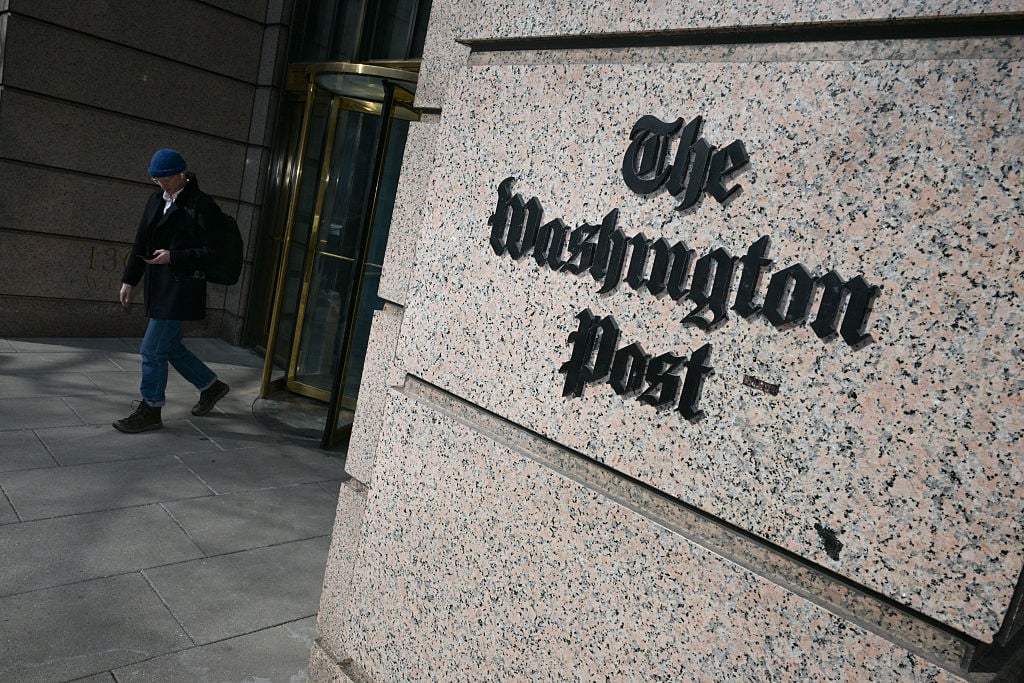
The Washington Post, long considered one of the leading newspapers in the United States, became the source of headlines across news platforms and social media after the paper announced massive layoffs across its reporting staff. For many, the cuts to the Post’s reporting staff demonstrate not only the shrinking landscape for print media but also the decline of a storied journalistic institution that has been criticized for giving in to political pressures.
The Washington Post lays off reporters, cuts entire sections
The Washington Post announced Wednesday that it was laying off one-third of its entire staff. It had been widely speculated that the Post would make significant cuts to its staff as a cost-saving measure, with the paper’s owner — Amazon founder Jeff Bezos — expressing his unhappiness with the paper for not being profitable. The cuts sweep across the entire paper, with endeavors like the Books section and the Post Reports podcast being eliminated altogether and the Post’s Metro section and international coverage being scaled back significantly.
Among the most dramatic cuts to the Post is the complete elimination of its sports department, with some sports reporters let go entirely and others reassigned to other roles within the paper. The move comes amid several major stories and events in the world of sports, including Super Bowl LX, the NBA trade deadline and All-Star weekend, and the beginning of the Winter Olympic Games. The closure of the Sports department had been suspected for some time, indicated by moves such as a decision not to send Post reporters to cover the Olympics in Milan and Cortina; after pushback, the Post later decided to send a small contingent to cover the Games. Additionally, journalist Charles Fishman posted on X, formerly known as Twitter, “The Washington Post laid off its entire award-winning photo staff. Every photographer, fired.”
Journalists react to losing jobs as Bezos criticized for political capitulation
After the layoff announcements, a number of Washington Post reporters posted about losing their jobs on social media. “In 2021, I was hired by @washingtonpost to cover health disparities & explore the way racism & social inequality affects health,” Akilah Johnson posted. “4 months ago, I became the generations’ reporter exploring how health is experienced by different pple across the life course. Today, I was laid off.”
The layoffs included journalists currently stationed overseas, some in dangerous environments. “I was just laid off by The Washington Post in the middle of a warzone,” Lizzie Johnson, the Post’s Ukraine correspondent, posted. “I have no words. I’m devastated.”
Bezos, who has owned the Post since 2013, has been accused in recent years of financially harming his businesses in order to give in to pressure from Trump, who has been hostile toward mainstream news outlets like the Post. During the 2024 presidential campaign, the Post lost hundreds of thousands of subscribers and several staff members after Bezos stepped in to stop the paper from publishing an endorsement of Vice President Kamala Harris. Karen Attiah, who was the Post’s only full-time Black columnist, said she was fired in September after posting comments critical of slain conservative activist and Trump ally Charlie Kirk. Amazon, which has recently cut thousands of jobs within the company, paid $75 million to purchase and market First Lady Melania Trump’s documentary Melania, which made less than $10 million in the U.S. during its opening weekend. Glenn Kessler, former writer of the Post’s The Fact Checker, accused Bezos of attempting to send a signal to Trump through scaling back the paper’s capacity. “Bezos is not trying to save The Washington Post. He’s trying to survive Donald Trump,” Kessler wrote in a Substack article.
Only Bezos knows for sure how economics, politics and other considerations factored into his decision to eliminate one third of the Washington Post’s staff. Regardless of the motivations, however, the cuts have left many veteran journalists to find new jobs, and the Post’s ability to cover stories in the United States and abroad appears to have been greatly diminished.