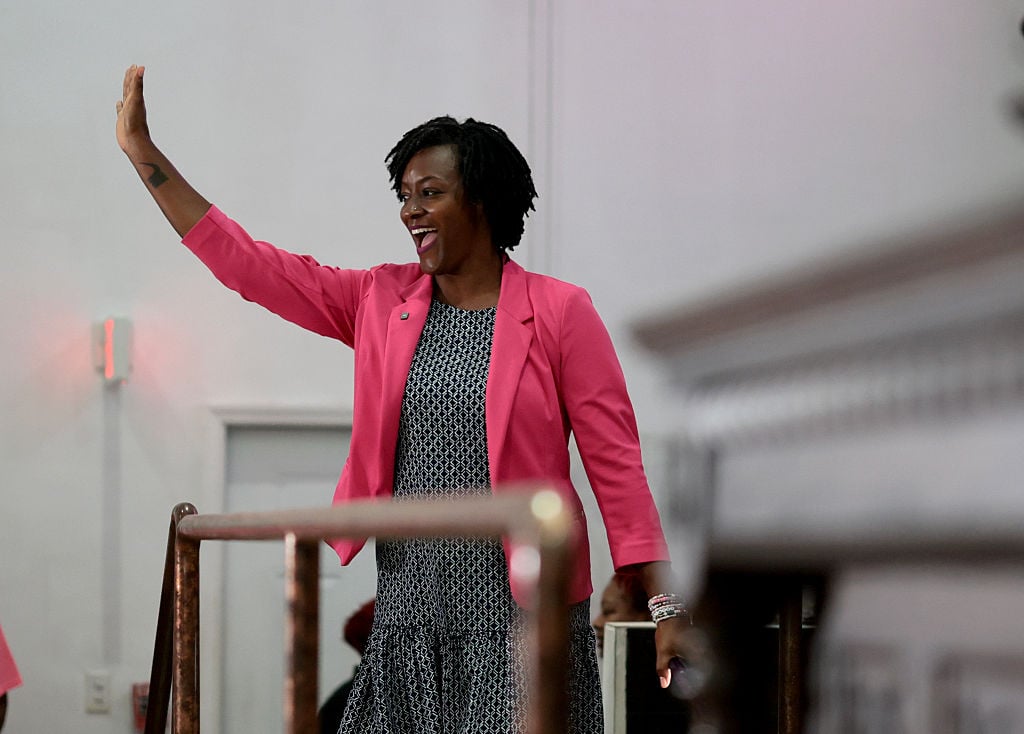
Another Democratic Socialist candidate has won a congressional primary, this time for a U.S. Senate seat to represent Florida. The unexpected victory over a more established Democratic candidate continues a notable but inconsistent wave of progressive victories within the party, and it adds to the drama of Democrats’ quest to regain control of both houses of Congress.
DSA-aligned Angie Nixon defeats Alex Vindman, Democrats’ pick for Senate race
Florida State Rep. Angie Nixon pulled off an upset victory in Tuesday’s U.S. Senate Democratic primary, defeating retired Lt. Col. Alex Vindman. Nixon, a member of the Democratic Socialists of America (DSA), won with over 56 percent of the vote compared to nearly 46 percent for Vindman. The result is a shocker given the support and name recognition enjoyed by Vindman, a former member of the National Security Council during President Trump’s first term who became a whistleblower. Vindman testified before Congress about Trump attempting to condition military aid for Ukraine on President Volodymyr Zelenskyy helping to dig up dirt on Joe Biden; the accusation was the basis of the first impeachment against Trump. Vindman had been recruited by Democratic leaders to run for the open Florida Senate seat, and he raised over $16 million in the primary campaign, compared to less than $1 million raised by Nixon.
Vindman spent most of the primary attacking Republican candidate Ashley Moody while expending little effort to campaign against Nixon, who in turn has touted her record as a state representative in standing up to right-wing Gov. Ron DeSantis. Her supporters also pushed back against the narrative that DSA candidates are less competitive, pointing to one poll that showed Nixon performing better than Vindman against Moody, who was hand-picked by DeSantis for the Senate race. Nixon, despite spending almost no money on traditional advertisements, was able to utilize her Jacksonville roots, union organizing experience and social media savvy to sway voters. She also won without the formal endorsement of the DSA, which she joined in June, though she did get an endorsement from progressive Gen Z Rep. Maxwell Frost (D-Florida). During her victory speech, Nixon challenged the notion that her platform was “extreme” while energizing her supporters for the general election race. “Ashley Moody can call it whatever she wants. She can call us whatever she wants,” Nixon told her enthusiastic crowd of supporters, “but in November she will call me Senator.”
Progressive and centrist Democrats seek to unify for general election
Nixon’s win is yet another example of a progressive wave within the Democratic Party, as DSA members and other progressive outsiders have won key congressional primaries in places like New York, Michigan and Colorado against incumbents and other establishment-backed candidates. However, the progressive wave has not been absolute, with more centrist candidates defeating DSA or other progressive candidates in Wisconsin’s governor’s race and Missouri’s 1st District. In Florida, Nixon’s victory coincided with primary wins for centrist House incumbents including Rep. Jared Moskowitz, who defeated a DSA-affiliated challenger, and Rep. Debbie Wasserman Schultz, who controversially switched to running in a plurality-Black district after Republican gerrymandering carved up her current district.
Other primary races between progressives and centrist, establishment Democrats have presented the challenge of consolidating these two wings of the party in order to compete against Republicans in November’s general election. Nixon weighed in concerning the divisions within the party earlier this year. In response to former Democratic National Committee Chair Jaime Harrison calling out candidates who “hate” the party but were running in its primaries, Nixon said that the Democratic Party needed reform and that she was working to make it better. In the case of the Florida Senate race, Democrats appear to be moving quickly to promote unity against Republicans. Nixon told Vindman supporters “there is a place for you” as she campaigns against Moody. “The great thing about our movement is we are not trying to force everyone to agree with us and believe exactly the same thing,” Nixon said. Vindman, meanwhile, said that Nixon “ran a strong campaign.” He pledged, “I will be standing by her side in the fight against Ashley Moody,” while telling his supporters “I hope you’ll join me.” And Senate Minority Leader Chuck Schumer and Democratic Senatorial Campaign Committee Chair Kirsten Gillibrand, both of New York, released a joint statement declaring “Angie Nixon has dedicated her career to fighting for Florida. A lifelong native of Jacksonville and a former union organizer, Angie’s dedication to put working families first runs deep.” The statement urges Democrats to support Nixon in the race against Moody.
Even with Democratic leaders’ support, Nixon faces a challenging race to defeat Moody in Republican-friendly Florida. But Nixon’s upset victory in the Democratic primary appears to have galvanized her supporters to bring that same energy to November’s general election, and her campaign will be a strong test case for the Democratic Party as it attempts to heal ideological divisions and put on a united front against the GOP.